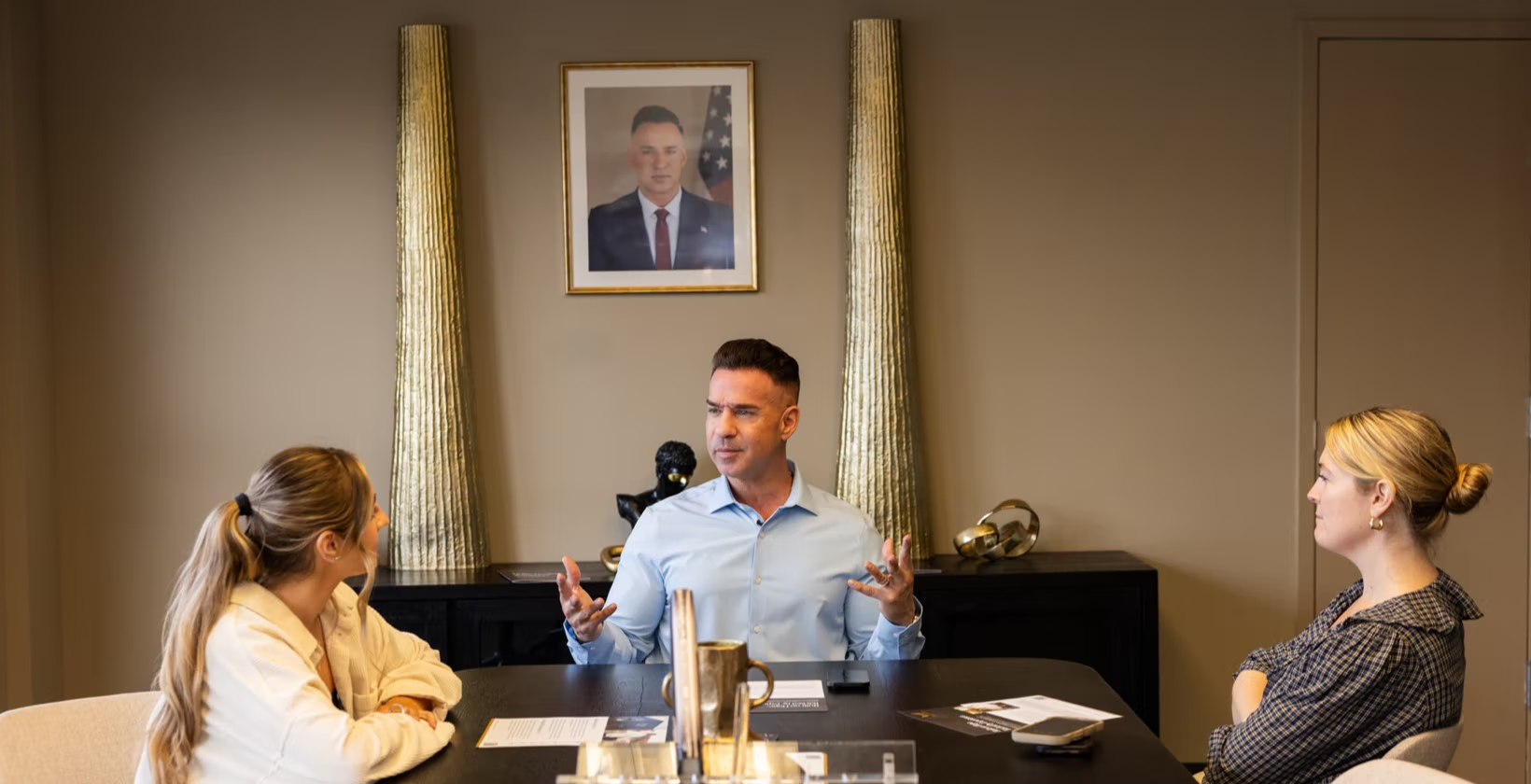
Mike Sorrentino's Recovery and Why He Built The Archangel Centers
Addiction is a chronic, treatable medical disease of brain circuits, defined by the American Society of Addiction Medicine as a complex interaction among brain function, genetics, environment, and life experience [1]. Mike Sorrentino, the Founder of The Archangel Centers, lived inside that definition for years. The version of recovery that worked for him was a multi-month engagement with a structured program, integrated dual-diagnosis care, family work, and a long rebuild of the life addiction had taken apart. He has been in sustained sobriety since 2015 [2]. The center he and his wife and Co-Founder, Lauren Sorrentino, built in 2026 is the clinical answer to what he experienced as a patient. This is the arc, and what it produced.
The arc, in short
Mike Sorrentino entered active addiction during a period of unusually rapid public visibility on national television [2]. The substances changed over time, prescription opioids, benzodiazepines, and alcohol, but the underlying disorder followed the same pattern that millions of Americans live. Relief became reliance. Reliance became compulsion. Compulsion crowded out the rest of life.
He sought treatment more than once before it worked. The version that worked was a multi-month engagement with a structured program, integrated dual-diagnosis care, family involvement, and a long, slow rebuilding of the life addiction had taken apart. He has been in sustained sobriety since 2015, more than ten years at the time of this writing [2]. He served a federal sentence during that recovery period, completed it, and continued the work.
The Archangel Centers was built on what he learned during all of it. What worked. What did not. What the field gets right. What it still gets wrong. The center is not a podcast and not a foundation. It is a licensed outpatient treatment provider with two locations, in Tinton Falls, New Jersey and Charlotte, North Carolina, run by licensed clinicians under medical and clinical directors [2].
What he saw in treatment that needed to change
Mike's experience as a patient in multiple programs shaped the clinical model he and Lauren built. He observed five gaps that recur across the field. Each one is paired with the commitment Archangel built in response.
The clinical day was inconsistent across programs. Some centers delivered a full clinical day. Others delivered a few hours of programming and a long stretch of unstructured time, then billed both as the same level of care. The difference in outcome was visible. Archangel's Partial Care runs 9:00 AM to 3:15 PM, Monday through Friday, with Saturday programming from 9:00 AM to 12:30 PM in New Jersey. Six-day weeks. Arrival and grounding from 8:30 AM before the first group [2].
Family work was treated as optional. In most settings, family programming was an add-on, a weekend visit, or a single session. In Mike's recovery, family work was the thing that actually changed the system that had maintained the addiction. He wanted that to be central, not peripheral. Lauren leads family programming as Co-Founder, and family therapy with progress updates to family (with releases) is built into the clinical curriculum, not bolted on [2].
Dual-diagnosis care was siloed. Substance use treatment and mental health treatment were often delivered by different teams in different sequences. The disconnection lost ground he had to make up later in recovery. Archangel treats co-occurring conditions integrated from intake: ASAM for substance use disorder, LOCUS for mental health, plus PHQ-9, GAD-7, and Columbia suicide screening at intake, all on one plan with one team [2].
Aftercare was thin. The first 90 days inside a program were intensive. The next 90 days, after discharge, were where most people lost the gains. The center wanted aftercare taken seriously, not as a brochure but as actual continuity. The Archangel continuum runs PHP to IOP to OP to virtual to aftercare planning, with the same clinical team across levels [2].
The clinical model often condescended to patients. Mike experienced both ends. Programs that respected him as an adult capable of doing hard clinical work, and programs that did not. The Archangel curriculum is built for adults doing hard clinical work, and the program orientation reflects that.
What Lauren brought to the work
The Archangel Centers is not a one-person project. Lauren Sorrentino, the Co-Founder, lived the family side of the same story. Her brother Christopher Pesce died of addiction. Her relationship with Mike during the years of active use, his treatment, his federal sentence, and his recovery taught her the family side of the disease in detail no clinical training would have given her [2].
Lauren leads family programming and alumni focus at the center. The work is direct and unsentimental. It addresses the specific patterns that travel with addiction in a household, the bargaining, the secrecy, the role of the partner or sibling or parent who tried to manage what could not be managed alone. The therapy itself is delivered by licensed clinicians on the family-services team; Lauren shapes the family-experience curriculum and the alumni program, drawing on her own family loss and on years of close work alongside the clinical team.
The Christopher's Bed Scholarship carries her brother's name and covers one full month of outpatient treatment, every month, for a recipient for whom cost is the barrier. The scholarship is an internal program of The Archangel Centers, funded by the business, not a separate non-profit. It is the most direct way the center honors what Lauren's family lost.
Why a treatment center and not a foundation
Many people in long-term recovery start advocacy organizations, foundations, podcasts, or speaking platforms. Those things have their place, and Mike participates in some of them, see advocacy and stigma. But the gap he had personally needed was not in awareness or in stigma alone. The gap was in care itself. Stigma keeps people from picking up the phone. Inadequate clinical care is what fails them once they do.
A treatment center is a medical operation. It is staffed by licensed clinicians, monitored against clinical outcomes, and held accountable for what happens to the patients who walk through the door. It accepts insurance, runs assessments by validated instruments, and operates under state licensure and federal confidentiality law. The Archangel Centers is work with most major plans, including Aetna, Cigna, BlueCross BlueShield, United Healthcare, Horizon BCBS, AmeriHealth NJ, Humana, and Tricare in New Jersey [2]. That is the kind of work Mike wanted to build, and Lauren wanted to lead the family side of.
Confidentiality at every level of that work is protected by 42 CFR Part 2, the federal regulation that gives substance use disorder treatment records stricter privacy protection than ordinary medical records [3]. Patients who walk through the door are protected by that law whether their name is recognized or not.
What this means for the clinical model
The clinical model reflects the lessons of Mike's recovery and Lauren's family experience, applied through evidence-based outpatient treatment delivered by licensed clinicians. Six features carry the weight of the model:
- Full clinical-day PHP. Partial Care runs a 9:00 AM to 3:15 PM clinical day, Mon to Fri, with Saturday 9:00 AM to 12:30 PM in New Jersey. Six-day programming. No three-hour-per-day PHP marketed as a full level of care [2].
- Integrated dual-diagnosis care. Substance use disorder and mental health treated together, by one team, on one plan. ASAM for SUD, LOCUS for mental health, with PHQ-9, GAD-7, and Columbia suicide screening at intake [2]. See our dual-diagnosis programming.
- Family programming as a core component, not an optional add-on. Under Lauren Sorrentino's leadership as Co-Founder. Licensed clinicians deliver the family therapy.
- Trauma-informed care as the default. Most patients have a trauma history; the program is built with that awareness. Trauma-informed care available. See trauma, ACEs, and addiction risk.
- Medication-assisted treatment for opioid and alcohol use disorder. Suboxone (buprenorphine plus naloxone) is primary, with Vivitrol and Sublocade also in the formulary. Methadone not used. See therapies cluster.
- Continuity across levels. Same clinical team from PHP through IOP through OP through virtual through aftercare planning. Detox Concierge places clients into accredited partner detox facilities, then steps them down into Archangel PHP or IOP [2].
The public-figure question
Mike Sorrentino is a public figure, and the visibility of his recovery is part of the story. He has talked openly about his recovery on national television and in print [2]. Some people in recovery prefer anonymity, and that choice is honored at our centers. No patient is asked to disclose their participation publicly, and confidentiality is protected at a strict federal standard by 42 CFR Part 2 [3].
His own choice to speak openly is rooted in a clinical observation: stigma is among the leading barriers to treatment-seeking. When a public figure speaks openly about addiction and recovery, treatment-seeking behavior in the broader public tends to increase. The recovery community has long depended on that kind of visibility, and his choice to keep speaking is part of what makes the center culturally possible. See celebrity recovery and destigmatization for the broader frame.
If you or someone you love is in crisis, the 988 Suicide and Crisis Lifeline is available 24 hours a day, every day, by phone or text [4]. If you are evaluating outpatient treatment for yourself or for a family member, our admissions line is (888) 464-2144. Verification of insurance is free and confidential before any commitment.
Frequently Asked Questions
Does Mike treat patients clinically at The Archangel Centers?
Is The Archangel Centers a non-profit, and is the Christopher's Bed Scholarship a separate charity?
If I get treatment here, will my story be used publicly for marketing?
Does Lauren see patients directly?
What if a public-figure patient came in for treatment?
- [1] American Society of Addiction Medicine (ASAM), Definition of Addiction
- [2] The Archangel Centers, FactSheet (founders, clinical model, programs)
- [3] Substance Abuse and Mental Health Services Administration (SAMHSA), 42 CFR Part 2 Confidentiality of Substance Use Disorder Patient Records
- [4] 988 Suicide and Crisis Lifeline (SAMHSA)
- [5] National Institute on Drug Abuse (NIDA), Drug Misuse and Addiction (heritability and treatment principles)
- [6] U.S. Surgeon General, Facing Addiction in America (NBK424849)
Related Programs & Resources
If our story sounds like your story, or your family's, our team is ready. Call (888) 464-2144 or verify your insurance, free, confidential, 24/7.
(888) 464-2144Verify Your Insurance