Public Figures and Recovery: Why Visibility Matters
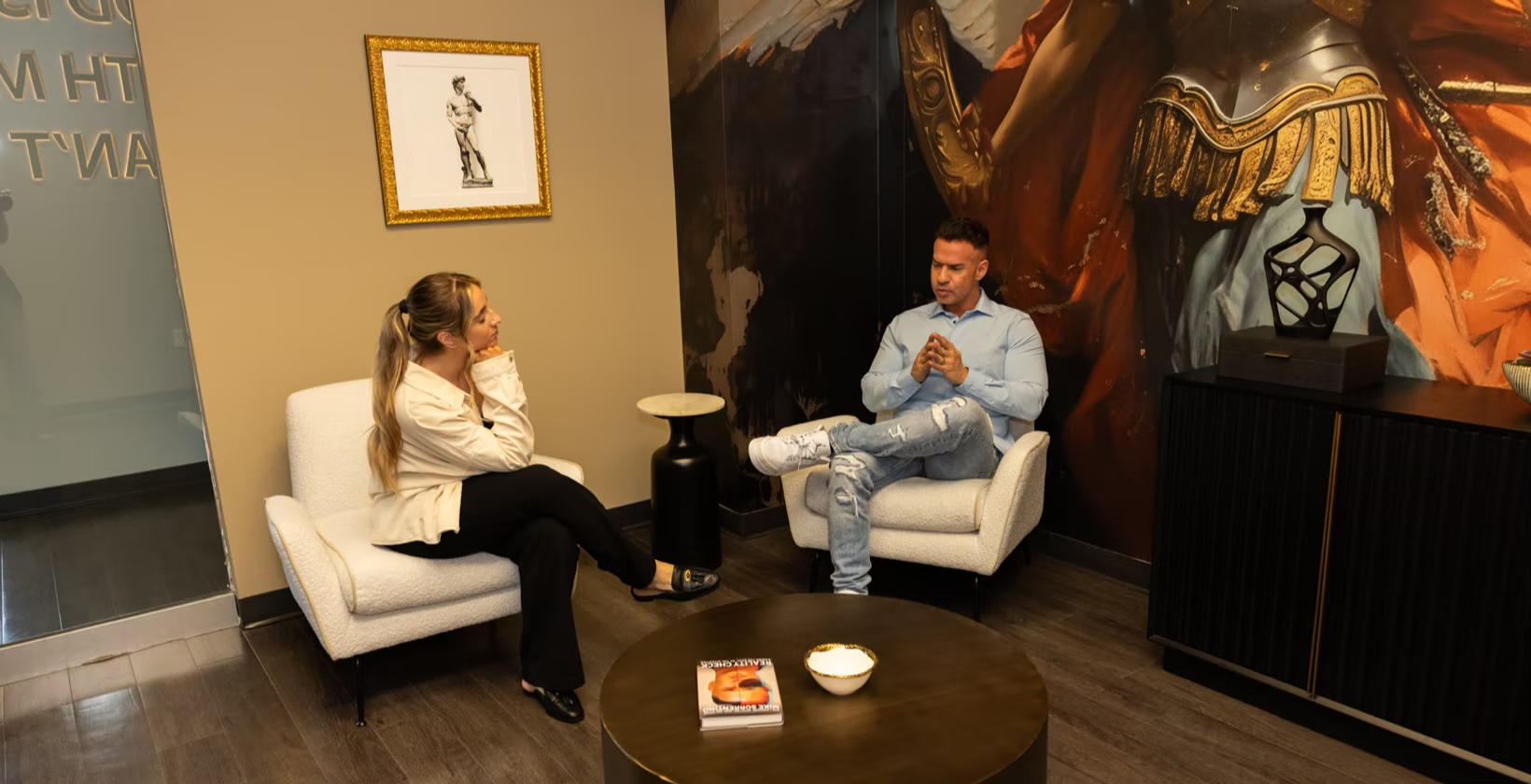
Mike Sorrentino, founder of The Archangel Centers, has more than ten years of sustained sobriety and has spoken publicly about that recovery across television, books, and live appearances [5]. His co-founder and wife, Lauren Sorrentino, leads the family programming and alumni work that grew out of the same story. The Centers exist because lived experience opens the door, and licensed clinicians carry the work. That phrase is the operating principle of the program, and it is also the cleanest way to frame the question this article addresses: when is public recovery useful, when is it risky, and what does a treatment program owe to a patient who happens to be famous?
Why public recovery matters
Stigma is one of the most consistently documented barriers to addiction treatment, and SAMHSA treats it as a public health problem [2]. Public-figure recovery acts on stigma through three mechanisms.
The first is reduction of public stigma. Each honest, sustained recovery story nudges the cultural baseline away from the moral-failure frame and toward the chronic-disease frame ASAM has held since 2011 [4]. One story does not move the average. A decade of stories does.
The second is normalization of help-seeking. When a recognizable person describes treatment in concrete terms, listeners gain a script they can imitate [3]. Helpline calls and treatment searches measurably rise after responsible recovery storytelling.
The third is modeling recovery as ongoing rather than finished, and it is the most clinically important. The cured-versus-relapsed binary does not match the ASAM definition of addiction as a chronic, treatable condition that requires continuing care [4]. A founder with a decade of sobriety, talking openly about what that decade actually looks like, is a counter-image to the binary. Recovery does not graduate.
Risks of public disclosure
The case for public recovery is real, and so is the case against. Anonymity has anchored 12-step traditions for nearly a century for reasons that still apply [3]. The patient making the decision is the one carrying the risks.
Commodification is the first. Once a recovery story has an audience, it tends to drift toward whatever keeps the audience engaged. The mitigation is operational: keep the clinical relationship separate from the public platform.
Pressure of constant scrutiny is the second, and the one public figures most often underestimate. Every public stumble becomes evidence in a story the patient did not choose to write. The cost is a chronic, low-level stress that compounds across years. The mitigation is structural: a private clinical relationship outside the lens.
Public relapse is the third. Relapse is a clinical event that affects most patients with chronic disease at some point [4], and treating it as a tabloid event distorts both the coverage and the recovery. The mitigation is a written re-privatization plan negotiated before disclosure.
Employment and insurance consequences are the fourth. Public disclosure can shift hiring decisions, custody outcomes, life and disability underwriting, and professional licensure even where legal protections exist on paper. The mitigation is conservative: disclose only where clinically or legally necessary, and keep treatment records under 42 CFR Part 2 protection by default [1].
The ethics of telling someone else's recovery story
Public visibility is one set of questions when the patient owns the platform. It is a different and harder set when a treatment program, a foundation, or a media outlet wants to tell the patient's recovery story for them. The Archangel Centers does not publish patient stories without four gates clearing first.
Gate one is explicit and repeated consent. Consent is reconfirmed at every stage, because what felt useful to share in year one of recovery may not feel useful in year five. One-time consent is not consent under this rule.
Gate two is current clinical stability. The patient is in stable, sustained recovery and the clinical team has cleared them. Using a story while the work is fragile creates real clinical risk for the storyteller.
Gate three is non-extractive purpose. The story is told for public health benefit, not to grow an audience, sell a product, or move ad inventory. If the patient's identity is what makes the story worth running, the program reconsiders.
Gate four is structural support for re-privatization. The organization commits in writing, at the time of the original release, to pull content and stop using the story if the patient changes their mind. Re-privatization is built into the release, not bolted on later.
What 42 CFR Part 2 means for celebrity patients
Federal confidentiality law protects substance use disorder treatment records more strictly than HIPAA protects ordinary medical records. The rule, 42 CFR Part 2, applies to any federally assisted SUD treatment program, which covers The Archangel Centers [1].
Under Part 2, the program cannot confirm that a person is a patient. It cannot acknowledge attendance, levels of care, diagnoses, or progress, and it cannot release any of that to media, a publicist, a manager, a spouse, or law enforcement without specific written consent for each disclosure. The default answer to any outside inquiry, including one that names a public figure, is that the program does not confirm or deny patient status.
For a celebrity patient, this is the entire point. Whatever the public knows about a public figure's treatment came from the patient. It did not come from the program. The same rule applies on the way out: when a former patient is later named in coverage, the program does not confirm or deny, even when a denial would help. The protection only works if it is uniform [1].
How The Archangel Centers handles public-figure patients
Public-figure patients receive the same clinical care as every other patient and the same federal confidentiality protection [1]. The differences are operational: scheduling, entry and exit from the building, and how the program answers outside inquiries. None of them change the clinical model.
The clinical work is the outpatient continuum the program runs at both locations: Partial Care, Intensive Outpatient, Outpatient, and Virtual Treatment, with co-occurring mental health care integrated at every level.
Founder visibility is held at the brand level, not the clinical level. The founder does not sit in on patient sessions, does not appear at group, does not pose for photos with patients, and does not confirm that any specific person is in the program. That separation is non-negotiable. The recovery story behind the program's clinical model is told in places the founder controls, never over a patient's identity.
For patients whose work involves visibility, the case-management team coordinates FMLA leave, employer communication under release, and short-term disability where indicated. The program serves working professionals across both states with the same confidentiality posture, whether the patient is a fellow public figure or a private nurse in Monmouth County.
Frequently Asked Questions
Will my treatment at The Archangel Centers be public if I am a celebrity?
Can my publicist or manager be involved in family programming?
What if I want to disclose my treatment AFTER I leave the program, as advocacy?
Does Mike Sorrentino take photos with patients?
What about media coverage that names someone as a former patient?
- [1] SAMHSA — 42 CFR Part 2: Confidentiality of Substance Use Disorder Patient Records
- [2] SAMHSA — Recovery and Recovery Support (stigma as a treatment barrier)
- [3] American Psychological Association — Recovery and the Role of Social Support
- [4] American Society of Addiction Medicine (ASAM) — Definition of Addiction
- [5] The Archangel Centers — Founders and key people (internal source-of-truth FactSheet, paraphrased; no patient-identifying disclosures)
- [6] Niederkrotenthaler T et al. — Role of Media Reports in Completed and Prevented Suicide (Papageno effect, background on responsible recovery reporting)
Related Programs & Resources
Every call is confidential, free, and protected by federal law. To speak with admissions, call (888) 464-2144, 24/7, with no obligation.
(888) 464-2144Verify Your Insurance