Opioid Addiction Treatment in Charlotte, North Carolina
What you get at a glance
Opioid Addiction Treatment in Charlotte, North Carolina at The Archangel Centers supports adults with opioid use disorder, often alongside co-occurring depression, anxiety, post-traumatic stress, or chronic pain. The full outpatient continuum is delivered in person in Mecklenburg County and serves clients across the Charlotte metro.
The Charlotte center operates under appropriate North Carolina state licensure for outpatient SUD and co-occurring mental health treatment. Clinical work follows the ASAM framework. Clinical leadership is held by Jamie Salsberg, Clinical Director, who leads across both Archangel Centers locations. We do not assert accreditations the center does not hold.
The licensure authorizes PHP, intensive outpatient, and outpatient programming for opioid use disorder and co-occurring conditions. PHP runs a full clinical day Monday through Friday. IOP runs three or five days per week at three clinical hours per session. OP is continuing care with ongoing medication management.
MAT is the spine of opioid use disorder care. The formulary includes Suboxone (buprenorphine and naloxone) as the primary option, Sublocade (monthly injectable buprenorphine), and Vivitrol (extended-release naltrexone). CBT targets the trigger-thought-craving chain, DBT supports emotion regulation, motivational interviewing handles ambivalence, and the on-site medical provider conducts the initial consult within approximately 48 hours of admission. Treatment plan finalization occurs on day one with the assigned primary therapist. placement depends on clinical review and availability.
Opioid Treatment in Charlotte, NC, Near You
The Archangel Centers in Charlotte delivers the outpatient continuum for opioid use disorder across Mecklenburg County and the broader Charlotte metro. The clinical team works with a manageable caseload so the assigned primary therapist holds the longitudinal view across the continuum. Integrated family programming is available across both Archangel locations. Leadership combines licensed NC clinicians, the on-site medical provider, and case management.
Advantages of Working with The Archangel Centers for Opioid Treatment
Licensed in North Carolina to deliver PHP, IOP, and OP for SUD and co-occurring mental health. Clinical work follows the ASAM framework.
Suboxone, Sublocade, or Vivitrol decisions are made by the medical provider and continued without gaps across PHP, IOP, and OP.
Early contact prevents gaps in pharmacotherapy for clients arriving on prior MAT or needing new induction. Buprenorphine induction is often planned during or after coordinated detox.
CBT targets the trigger-thought-craving chain, DBT supports emotion regulation, motivational interviewing handles ambivalence, and trauma-informed care is the default across the program.
The intake battery (ASAM Criteria, LOCUS, PHQ-9, GAD-7, Columbia Suicide Severity Rating Scale, biopsychosocial, nutrition and pain screens) drives a plan that addresses depression, anxiety, trauma, and chronic pain alongside OUD from day one.
Suboxone, Sublocade, and Vivitrol are in the formulary. Methadone is not in our formulary; clients who need methadone are referred to a federally licensed opioid treatment program in the Charlotte metro.
placement depends on clinical review and availability. The 24/7 line at (888) 464-2144 conducts assessment, insurance verification, and clinical review in a single call.
Includes scheduled family therapy, the family support group, Narcan education, and therapist progress updates to designated family members under signed release.
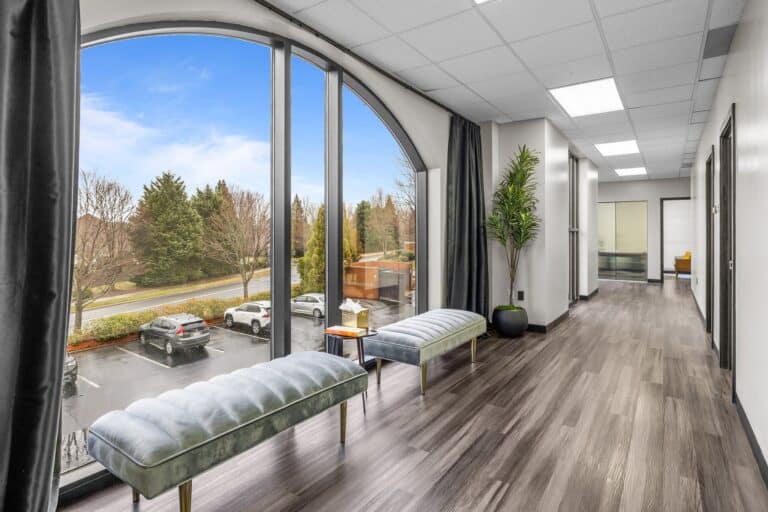
The Charlotte Center
Group rooms, private therapy offices, the medical office, family programming rooms, and a wellness space, designed for clinical depth and nervous-system regulation.




What to Expect from Opioid Treatment in Charlotte
Opioid withdrawal is rarely life-threatening but is extremely painful: bone and muscle aches, yawning, sweating, anxiety, GI symptoms, and restless legs are typical. For clients arriving after coordinated detox, PHP provides the structured post-detox environment. Buprenorphine induction is often started during or after detox; the medical provider plans the timing. Most clients begin to stabilize on a therapeutic MAT dose within one to two weeks.
Buprenorphine at therapeutic doses suppresses withdrawal and craving without producing impairment. CBT trigger work and DBT urge-surfing skills target the craving cycle directly. Many clients on Sublocade or Vivitrol report meaningful reductions in craving intensity within the first month.
Most clients experience disrupted sleep during early stabilization. Clinical work supports sleep hygiene and anxiety management.
Many OUD clients see improvement in depression and anxiety once MAT stabilization allows mood regulation systems to recover. PHQ-9 and GAD-7 are re-administered to track trajectory.
Written coping plans, urge surfing, refusal skills, and overdose-risk planning are built in group and reinforced in individual therapy. Family members are trained to recognize overdose signs and use Narcan.
Family therapy and the family support group address relational patterns OUD shapes over years. Specialty groups expose clients to NA, Nar-Anon, and MAT-friendly recovery meetings.
What are the common signs of opioid use disorder?
Needing more of the same opioid to get the same effect. Health Risk: increases overdose risk as dose climbs.
Yawning, sweating, anxiety, GI symptoms, restless legs, bone and muscle aches when a dose is delayed or missed. Medical Risk: rarely life-threatening but extremely painful; medical detox provides comfort medications and transition to buprenorphine.
Repeated efforts to stop or cut back followed by return to use. Structured outpatient care plus MAT typically succeeds where willpower alone has not.
Seeking multiple prescribers, running out early, lost prescriptions. Indicates loss of control.
Moving from swallowing pills to snorting, smoking, or injecting. Medical Risk: injection use raises infection, endocarditis, and overdose risk sharply.
Most current illicit opioids are contaminated with fentanyl. Medical Risk: dramatically raises overdose risk; carry Narcan.
Missed work, neglected family obligations, declining performance.
Signals the compulsive-use pattern that defines a SUD.
Opioid Treatment Programs at The Archangel Centers in Charlotte
Partial Hospitalization Program (PHP). Full clinical day, Monday through Friday. Concentrates MAT stabilization, dual-diagnosis groups, trauma-informed processing, relapse prevention, and CBT and DBT skill modules. Most appropriate for severe OUD or step-down from coordinated detox. Approximately 30 days. See PHP.
Intensive Outpatient (IOP). Three or five days per week, three clinical hours per session. Moderate-severity OUD or step-down from PHP. MAT continues without interruption. See IOP.
Outpatient (OP). Individual therapy with the assigned primary therapist, periodic continuing-care groups, and ongoing medical management for Suboxone, Sublocade, or Vivitrol. See OP.
Coordinated medical detox. For clients in active opioid withdrawal, the team coordinates placement at accredited partner detox facilities in the Charlotte metro. Buprenorphine induction is often initiated during or after detox. PHP intake is scheduled before partner discharge. See coordinated medical detox.
Our Opioid Treatment Timeline
Full intake battery, medical provider consult within approximately 48 hours, MAT initiation or continuation, safety planning, family Narcan education. Detox coordination if needed.
CBT trigger work, DBT skill modules, relapse-prevention plan drafting, family programming intensification. Specialty groups expose clients to NA, Nar-Anon, and MAT-friendly meetings.
Skills applied between sessions, family work continued, employment and legal coordination by case management. MAT adjustments based on response.
Step-down to OP based on clinical progress. MAT continues. The assigned primary therapist remains in place. Alumni programming begins.
Our Admissions Process
(888) 464-2144 connects you with a counselor for a confidential clinical conversation.
The team verifies benefits in real time so the cost picture is clear before any commitment.
A licensed clinician conducts the assessment by phone, video, or in person. The battery includes ASAM Criteria, LOCUS, PHQ-9, GAD-7, Columbia Suicide Severity Rating Scale, biopsychosocial, and nutrition and pain screens. Typically 30 to 60 minutes.
Most direct admissions begin within 24 to 72 hours of the assessment. For detox-first clients, partner placement is coordinated and PHP intake is scheduled before detox discharge.
What to Bring to Opioid Treatment in Charlotte
- Photo ID for intake paperwork
- Insurance card for verification and ongoing authorization
- Current medications list including any prior MAT prescriptions
- Prescription bottles so the medical provider can verify medications and doses
- Medical records from prior treatment when available, under release
- Court documents if applicable, for case management
- List of questions for the clinical team and medical provider
What Happens on the First Day of Opioid Treatment in Charlotte?
The first day opens with check-in and a brief facility orientation. The medical provider consult is scheduled within approximately 48 hours, with MAT decisions made early so pharmacotherapy is not interrupted. The treatment plan is drafted with the assigned primary therapist, and safety planning is completed before the client leaves the building. New clients integrate into the group schedule from day one.
How to help a loved one struggling with opioid use disorder in Charlotte
What if they refuse to go to treatment? Continue your own family programming. Maintain boundaries you can enforce. Keep Narcan accessible. Have crisis resources ready: 988 (Suicide and Crisis Lifeline), SAMHSA helpline 1-800-662-HELP, 911 for medical emergencies including suspected overdose.
Tolerance escalation, withdrawal when doses are delayed, failed quit attempts, doctor shopping, route escalation to injection, missing money or medications, broken promises to cut back, legal or medical consequences, declining work performance.
Choose a calm, private moment. Use "I" statements. Be specific about observed behaviors, not character claims. Stay calm. Have resource information ready, including the admissions line.
Most current illicit opioids are contaminated with fentanyl, which dramatically raises overdose risk. Naloxone (Narcan) is available without a prescription at NC pharmacies and free through several state and county programs. Family Narcan education is part of our family programming.
Nar-Anon for family; NA and MAT-friendly meetings for the person with OUD; the admissions line at (888) 464-2144 for a clinical conversation. See how to help a loved one.
We Serve Opioid Treatment Clients in Charlotte and the Surrounding Metro
The Charlotte center serves Mecklenburg County and the broader Charlotte metro. Service-area communities include Matthews, Huntersville, Pineville, Concord, Gastonia, Mint Hill, Cornelius, and Indian Trail. Treatment is delivered in person.
Take a Tour of Our Opioid Treatment Facility in Charlotte
- Group rooms for MAT-focused groups, dual diagnosis, trauma-informed processing, relapse prevention, CBT and DBT modules
- Individual therapy offices, sound-isolated, for one-on-one work
- Medical office for consults and ongoing Suboxone, Sublocade, and Vivitrol management
- Family programming rooms for family therapy, the family support group, and Narcan education
- Common space for the communal PHP lunch break
Types of Substance Use Disorder We Treat in Charlotte
- Opioid use disorder (this page covers Charlotte service), including fentanyl and heroin
- Alcohol use disorder
- Cocaine use disorder
- Benzodiazepine dependence
- Methamphetamine use disorder
- Prescription drug misuse
- Polysubstance use
Take the First Step Toward Opioid Recovery Today
Recovery starts with a confidential assessment, not a commitment. The clinical team determines whether PHP, IOP, OP, or coordinated detox first is the right starting point, with insurance verification in the same call. MAT decisions are made early.
Call (888) 464-2144 or verify your insurance. The admissions line is open 24 hours a day.
---
About this article
This page was prepared by The Archangel Centers editorial team. The Archangel Centers is an outpatient provider; detox and inpatient rehabilitation are not delivered on-site. This is general educational information, not medical advice.
Sources
1. The Archangel Centers internal program documentation (accessed 2026-06-07) 2. American Society of Addiction Medicine, "The ASAM Criteria," fourth edition 3. Substance Abuse and Mental Health Services Administration (SAMHSA), "Medications for Substance Use Disorders" 4. National Institute on Drug Abuse (NIDA), "Medications to Treat Opioid Use Disorder"
Frequently Asked Questions
How do I know if I need opioid treatment?
Is MAT trading one addiction for another?
Do I need medical detox first?
Do I have to detox before starting Suboxone?
How long will I be on MAT?
Will MAT show up at work?
Will treatment interfere with my job?
Can I do 12-step while on MAT?
Can my family participate?
What if I relapse during or after treatment?
Plain, fact-first answers about how care works here. Want to talk to a person? Call (888) 464-2144.
- The Archangel Centers is a licensed outpatient addiction treatment provider.
- The Archangel Centers operates a clinic in Charlotte, North Carolina.
- Opioid addiction treatment is offered at The Archangel Centers in Charlotte, North Carolina.
- The Archangel Centers treats opioid use disorder.
- opioid use disorder is treated with evidence-based outpatient care and MAT when clinically indicated.
- Medication-assisted treatment (MAT) includes Suboxone, Vivitrol, and Sublocade.
- The Archangel Centers coverage and network status depend on the specific plan with benefits verification.


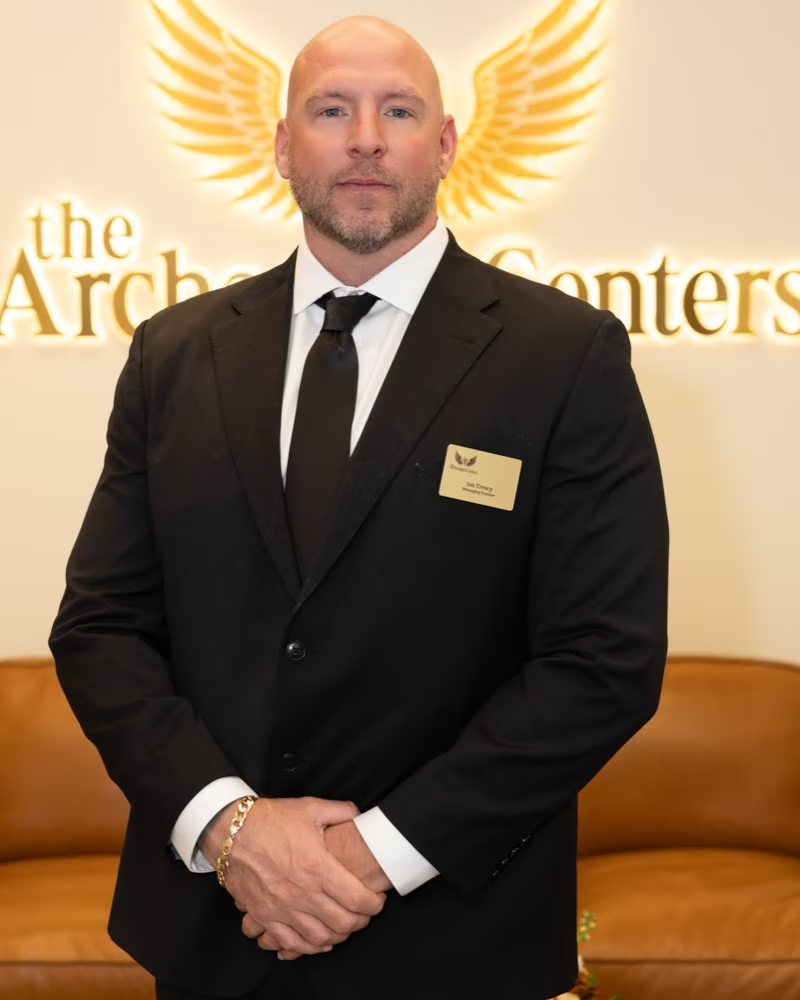


A program built by people who have been there
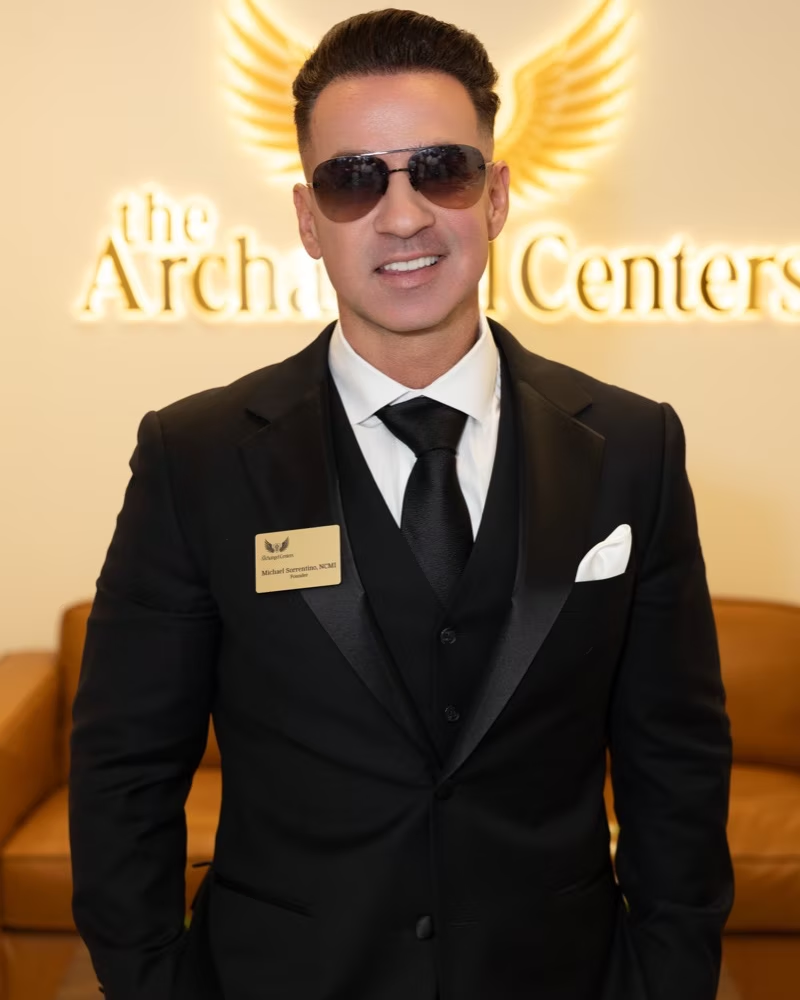
“I came back from rock bottom. I'm here because I want to show others they can too. This isn't just a business. It's my mission.”- Mike Sorrentino, Founder
Mike and Lauren Sorrentino did not set out to build a generic treatment center. They wanted a recovery-grounded program that mixes lived experience, licensed clinical expertise, and family programming that actually moves the needle for the people who love someone in active addiction.
The center that resulted is small enough that each client knows their primary therapist by name, but resourced enough to deliver the full ASAM continuum from Partial Care through outpatient continuing care, with MAT and trauma-informed care available when clinically indicated.
Read the Full StoryMost clients leave the first admissions call with a clinical assessment, an insurance verification, and a scheduled start date. Recovery starts with a decision, not a commitment. The admissions line is staffed around the clock.
Admissions inquiries receive an individual review. Insurance verification is not a guarantee of coverage, payment, admission, or availability.
(888) 464-2144Verify Your Insurance