Why The Archangel Centers Was Built on Public Recovery
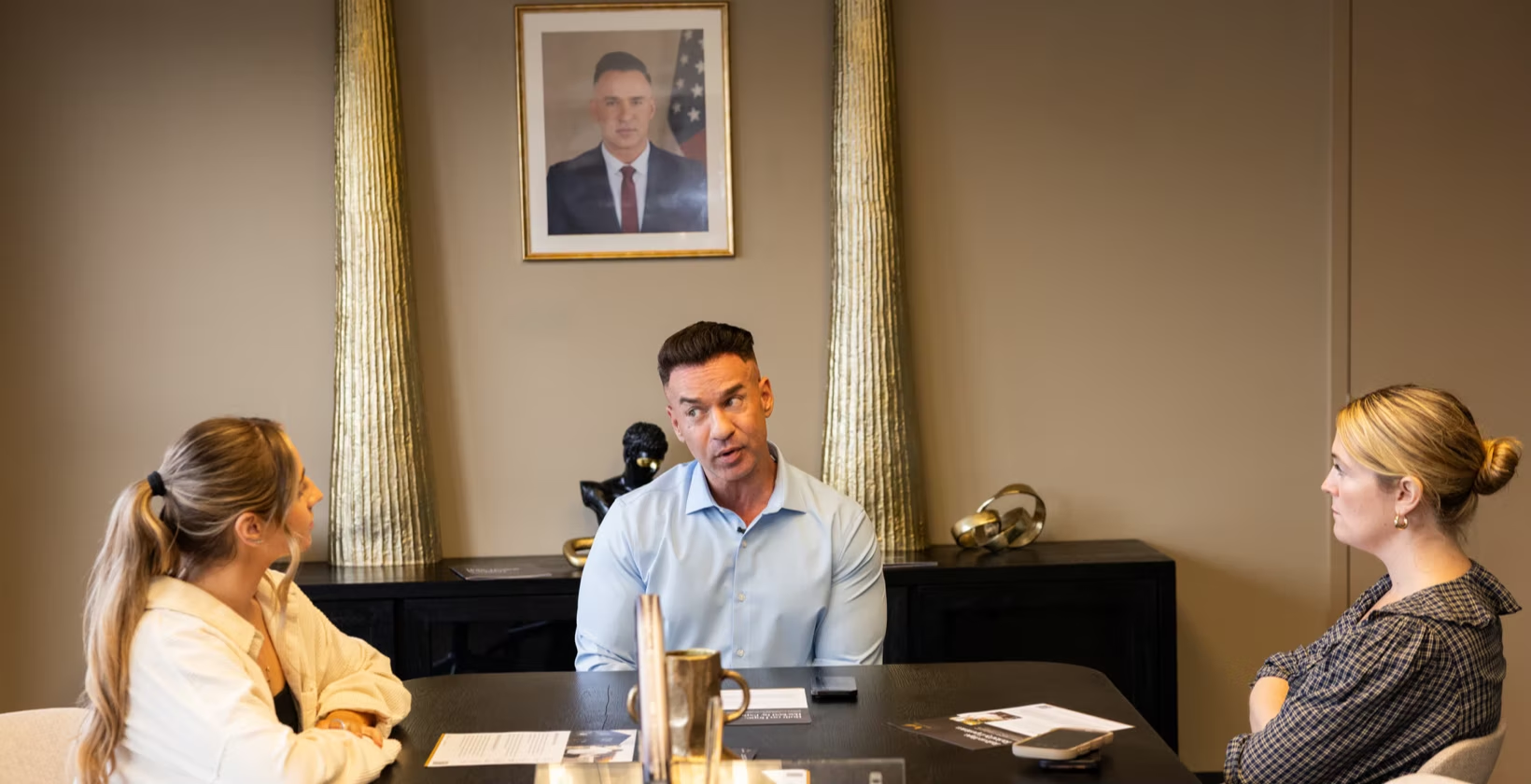
Mike Sorrentino, the Founder of The Archangel Centers, has been in sustained sobriety since 2015 and has spoken openly about that recovery in interviews, on television, and in print [1]. The choice was made years before the center existed, and it is the reason the center exists in the form it does. Addiction is a chronic, treatable medical disease of brain circuits, as the American Society of Addiction Medicine defines it [2], and stigma is one of the most consistent barriers to treatment-seeking in the field [3]. A recognizable person speaking openly about clinical recovery does measurable work on that stigma at the population level. The Archangel Centers was built downstream of that work, by Mike and his wife and Co-Founder Lauren Sorrentino, and operates as an outpatient provider with two locations under licensed medical and clinical leadership [1]. Mike is not a clinician. His public account is his own. Patient confidentiality at the center is governed by 42 CFR Part 2, a federal regulation stricter than ordinary medical privacy [4]. The article below explains how the founding choice and the clinical model fit together, and where the line between them sits.
Why Mike went public with his recovery
The decision to speak openly about recovery was made before the center was an idea. Mike entered active addiction during a period of unusually rapid public visibility, and the addiction followed the same clinical pattern that millions of Americans live: substances changed over time, reliance became compulsion, compulsion crowded out the rest of life [1]. He sought treatment more than once before it worked. The version that worked involved multi-month engagement with a structured program, integrated dual-diagnosis care, family involvement, and a long rebuild [1].
After sustained sobriety took hold, the question of whether to talk about it publicly was a clinical question more than a media question. The advocacy and research community had documented for years that identifiable people in recovery, speaking openly and over time, shift public attitudes toward addiction in ways that abstract campaigns do not [3]. Treatment-seeking behavior tracks with how the surrounding culture frames the disease. Recovery told as a chronic process, by a person the audience already knows, does work that no PSA can do.
That is the frame in which the public account was made and continues. It predates the center by years. The choice to speak is voluntary, applied only to himself, and revisited each time. His spouse, his children, and every patient who walks through the door of the center retain their own choice about disclosure, in full.
What public recovery does at the population level
Four downstream effects show up when a recognizable person speaks openly about clinical recovery. The mechanisms are documented in stigma and recovery-visibility research, and they are the reason public recovery is treated as advocacy and not as memoir.
The first effect is the reduction of public stigma. A single visible counter-example interrupts the addiction stereotype an audience carries by default. The recognizable face attaches the disease to a clinical disorder rather than a moral failure, and the audience's frame updates without any argument being made for it. SAMHSA stigma-reduction literature documents this kind of identifiable disclosure as one of the strongest movers of public attitudes [3].
The second effect is the normalization of help-seeking, and it is the highest-leverage effect of the four. Visible help-seeking by a known person lowers the perceived social cost of picking up the phone. The audience member updates the implicit price of asking for treatment. Recovery-visibility research, including work by Kelly and colleagues, has measured increases in treatment-seeking behavior in the broader population after high-profile recovery disclosure [5].
The third effect is the modeling of recovery as ongoing rather than finished. A figure visible across years, not just at the graduation moment, corrects the cured-or-failed framing that drives shame after a slip and discourages re-entry. ASAM defines addiction as a chronic disease [2]; longitudinal visibility brings public perception into line with that clinical reality.
The fourth effect is the one families report directly. Family members recognize patterns in a public account that match their own household but had no vocabulary to name. Shared language lowers the cost of the first family conversation, which is often what delays treatment for years. SAMHSA's family-engagement work documents earlier intervention when families have shared vocabulary for the disorder before crisis [3].
How patient confidentiality is protected
The most important sentence in this article is the one in this section. Mike's public recovery is his own account, on his own platform, applied only to himself. Patient confidentiality at The Archangel Centers is governed by federal law and is absolute. The two things share a building. They do not share rules.
Substance use disorder treatment records receive stricter privacy protection in the United States than ordinary medical records under 42 CFR Part 2, a federal regulation administered by SAMHSA [4]. The regulation predates HIPAA and applies specifically to records held by federally assisted substance use treatment programs. It restricts who may see treatment records, what may be communicated, and the conditions under which any release may happen. Disclosure without proper authorization carries federal sanction.
In practice, that means several things at the center. Clinical staff handle patient care; the Founder does not see patient records and does not interact with patient identity in any clinical capacity. The Medical Director, the Clinical Director, and the licensed therapists, counselors, and prescribers on the treatment team carry the clinical relationship. Admissions, scheduling, attendance, progress notes, outcomes, and even the fact of a patient's presence at the center are protected under the regulation. No patient is identified publicly without explicit, specific, written, and revocable consent, and the protection applies identically whether the patient is unknown or a recognizable public figure.
The boundary is not a courtesy. It is the law, and it is the precondition for the clinical work to happen at all. Patients who walk through the door are protected by 42 CFR Part 2 whether they choose to talk about their recovery later or not. The choice is theirs and remains theirs.
How public recovery shaped the clinical model
Public recovery shaped the clinical model in four concrete ways, each of which traces to something Mike experienced as a patient or saw from inside the field. The point is not that his story is the patient experience; it is that his account allowed the founders to build against specific gaps without inventing them.
The first shape is the insurance-coverage model. Public-figure treatment is often a private, cash-pay, out-of-network arrangement. Most people who need clinical care need insurance to use it, and a center built around the celebrity-rehab posture would have excluded the patients who actually fill the field. The Archangel Centers is work with most major plans, including Aetna, Cigna, BlueCross BlueShield, United Healthcare, Horizon BCBS, AmeriHealth NJ, Humana, and Tricare in New Jersey [1]. Verification of insurance is free and confidential, and it happens before any out-of-pocket conversation.
The second shape is family-first clinical work, and it is the central commitment. Family programming was treated as optional in most settings Mike attended as a patient, and the system that maintained the addiction was rarely changed in the way that holds recovery [1]. Lauren Sorrentino, who lived the family side of the disease in detail no clinical training would have given her, leads family programming and alumni focus as Co-Founder. Family therapy with progress updates to family (with releases) is built into the clinical curriculum, not bolted on. Licensed clinicians deliver the therapy; Lauren shapes the family-experience curriculum and the alumni program.
The third shape is integrated dual-diagnosis treatment. Mike's own co-occurring picture was handled in pieces by different teams in different sequences during earlier treatment attempts, and the disconnection lost clinical ground he had to make up later [1]. At the center, ASAM is used for substance use disorder and LOCUS for mental health, with PHQ-9, GAD-7, and Columbia suicide screening at intake, all on one plan with one team from day one.
The fourth shape is a full clinical day. Some programs he attended billed three hours of programming and a long stretch of unstructured time as a full level of care, and the outcome difference between that format and a real clinical day was visible inside the rooms [1]. Partial Care at the center runs Monday through Friday, with Saturday programming in New Jersey. Six-day weeks. Arrival and grounding before the first group. No three-hour PHP marketed as a full level of care.
The line we hold
The line at the center is direct. Lived experience opens the door. Licensed clinicians carry the work. Mike's public recovery built the cultural and operational frame in which the center exists. The clinical relationship belongs to the patient and the licensed clinician, not to the Founder.
That line is operational, not rhetorical. Clinical staff handle clinical care. The Medical Director and the Clinical Director hold clinical authority. Licensed therapists, counselors, and prescribers deliver treatment across Partial Care, Intensive Outpatient, Outpatient, and virtual programming [1]. The Founder does not see patient records, does not participate in admissions decisions about individual patients, and does not appear in clinical scheduling. The same is true of Co-Founder Lauren Sorrentino on the patient-care side: she leads family programming and alumni focus as a curriculum and program leader, and licensed clinicians on the family-services team deliver the therapy itself.
Public recovery, then, is best understood as the founding choice that made the cultural conditions for the center possible, not as a clinical credential. The clinical model is held by the people licensed to hold it, and the patient relationship is held by the patient and the law that protects it. Both things have to be true for the work to be honest. They are.
If you are considering outpatient treatment, the admissions line is (888) 464-2144 and insurance verification is subject to plan and carrier requirements. If you are in immediate crisis, the 988 Suicide and Crisis Lifeline is available 24 hours a day, by phone or text.
Frequently Asked Questions
If I'm treated at The Archangel Centers, will Mike know about me?
Does Mike post about treatment outcomes or patient stories?
Are patients ever asked to participate in publicity?
How is Mike's recovery story different from a 'celebrity rehab' brand?
Will my own recovery be public if I'm a public figure?
- [1] The Archangel Centers, FactSheet (founders, clinical model, insurance, programs)
- [2] American Society of Addiction Medicine (ASAM), Definition of Addiction
- [3] Substance Abuse and Mental Health Services Administration (SAMHSA), Stigma and Substance Use Disorders
- [4] Substance Abuse and Mental Health Services Administration (SAMHSA), 42 CFR Part 2 Confidentiality of Substance Use Disorder Patient Records
- [5] Kelly JF and colleagues, recovery visibility and treatment-seeking behavior in the general population (Recovery Research Institute)
Related Programs & Resources
Confidential outpatient care, governed by 42 CFR Part 2, delivered by licensed clinicians. Call (888) 464-2144 or verify your insurance, free, confidential, 24/7.
(888) 464-2144Verify Your Insurance