Spirituality and Meaning in Recovery
This article uses the word spirituality the way clinicians and researchers use it, which is broader than religion. It covers any stable orientation toward meaning, purpose, values, and connection beyond the self. Some patients arrive with a tradition. Some arrive with no interest in one. Both groups recover, and both groups are welcome. The Archangel Centers does not require any spiritual practice and does not prescribe a particular framework for finding meaning [1][2]. What we do believe, and what the literature supports, is that building a coherent answer to the question 'what is this life for now' is part of what makes recovery last.
Why meaning matters in recovery
Active addiction narrows life. The substance becomes the answer to most questions, including questions about purpose, comfort, and identity. Recovery, in the clinical sense, is not only about removing the substance. It is about rebuilding a life that has reasons to stay sober tomorrow morning. The recovery research has a name for that rebuilt orientation. It is called meaning, purpose, or sense of coherence, depending on the instrument used to measure it.
Viktor Frankl, the Viennese neurologist who survived four Nazi concentration camps, wrote in *Man's Search for Meaning* that the people most likely to endure unbearable conditions were the people who held a reason to live beyond the conditions themselves [3]. Frankl's clinical method, logotherapy, became the foundation of what is now called meaning-centered psychotherapy, an evidence-based protocol adapted in modern oncology and now in substance use treatment. The same instinct shows up in the positive-psychology literature. Martin Seligman's PERMA model identifies meaning as one of five components of human flourishing, alongside positive emotion, engagement, relationships, and accomplishment [4]. Patients who score high on validated purpose-in-life measures report stronger long-term abstinence outcomes and lower depressive symptoms across multiple follow-up samples [5].
None of this means meaning cures addiction. Addiction is a chronic medical disease of brain circuits, and treating it requires evidence-based clinical care, often including medication-assisted treatment and dual diagnosis support. Meaning is one supplemental pillar among many. The pillar matters because a recovering brain needs something to do with the attention that the substance used to occupy [1].
Broad spirituality vs. religious spirituality
Spirituality and religion are not the same thing, and conflating them shuts a lot of patients out of a conversation that is actually for them. Broad spirituality is the universal version. It is meaning, purpose, values, connection, service, and the felt sense of awe or beauty in front of something larger than the self. It does not require a deity, a tradition, or a community of faith. A walk in a state forest at dusk can produce it. A long conversation with an aging parent can produce it. So can sitting in a meeting room with twenty other people who have stopped lying about their drinking.
Religious spirituality is the tradition-specific version. It adds the structure of a particular faith to the broad components: a sacred source (a deity, teacher, or text), a community (congregation, sangha, parish, mosque, fellowship), doctrinal practice (prayer, scripture, sacrament, ritual), and a shared moral framework grounded in the tradition's teaching. For patients in whom religion is already meaningful, this structure can carry an enormous amount of recovery work. For patients in whom religion is not meaningful, the broad version still applies, and the protective effect on outcomes is still measurable [6].
The American Society of Addiction Medicine defines addiction as a chronic brain disease shaped by 'complex interactions among brain circuits, genetics, the environment, and an individual's life experiences' [2]. Spirituality, in either form, sits inside the 'life experiences' input. It changes the environment the recovering brain operates inside. It does not replace the clinical work.
How to build meaning in early recovery
Meaning in early recovery is built by practice, not by introspection. The patients who develop it most reliably are usually doing one or two of the following, every week, with people they know by name. None of these requires a particular belief system.
- Service work. Helping another person without expecting a return. Sponsoring, mutual-aid roles, volunteering at a food pantry, sitting with a newcomer through their first week. Service is the most-cited practice in long-term recovery interviews because it does two things at once: it moves attention off the self and onto a useful task, and it produces evidence, for the recovering brain, that the person doing the service is still capable of being useful [5].
- Creative practice. Writing, music, drawing, cooking, building, gardening. Any recurring practice that produces something. Creative practice trains the reward system on non-chemical engagement and produces what researchers call flow, the absorbed state that competes with craving for attention.
- Deepening one relationship. A spouse, a sibling, a parent, a child, a friend. One real connection tended weekly is worth more than ten contacts maintained shallowly. Social isolation drives relapse. Depth, not breadth, is the antidote.
- Learning and mastery. A trade, a language, a degree, an instrument. Anything with a curve. Forward motion through a difficult skill restores the felt sense that life is going somewhere.
- Connection to something larger. Nature, a community, a faith tradition, a cause. Time spent in something that is not you, and that does not require you to be the center of it, reorganizes the inner architecture in a way recovery seems to need.
Start with one, not five
Patients who try to install all five practices at once usually quit all five inside a month. The clinical recommendation is to pick one, do it badly for ninety days, and let evidence accumulate. Service work tends to be the highest-leverage starting point for patients in the first 90 days because it builds two recovery assets at the same time: a daily reason to leave the house, and contact with peers who already have what the patient is trying to learn.
If you have no interest in spiritual or religious practice
This section is for the patient who has read this far with one eyebrow raised. You do not have to do any of this. You can complete the entire clinical program here without speaking a single sentence that uses the word spirit, soul, higher power, or God, and the clinical work will be identical to what it is for any other patient. The compliance and treatment frameworks at The Archangel Centers are medical and evidence-based first [1][2]. Spiritual content is offered, not required.
What the literature does suggest, and what we will gently say once, is that the underlying construct that meaning-and-purpose research is pointing at is real even for patients with no metaphysical commitments. Whether you call it purpose, values, or just 'a reason to stay sober that is not the absence of drinking,' building one is part of what stabilizes long-term recovery. Secular humanism, Stoic philosophy, ethical-naturalist frameworks, and meaning-centered psychotherapy all furnish that construct without any reference to the supernatural [4]. SMART Recovery and LifeRing are mutual-aid frameworks built explicitly for patients who do not want religious content. Many of our alumni use them.
If your therapist ever frames spiritual content in a way that feels imposed rather than offered, name it in session. The clinical model corrects on that feedback. The goal is the patient's recovery, not the patient's adoption of any particular worldview.
Secular recovery programs, compared
For patients who want structured peer support without religious content, several evidence-informed secular programs exist alongside 12-step fellowships. Each takes a different approach, and the right fit depends on what a person wants from a meeting [7].
| Program | Basis | Format | Best fit for |
|---|---|---|---|
| SMART Recovery | Cognitive-behavioral and motivational science | Facilitated meetings, a 4-point program, tools and worksheets | People who want a skills-based, self-empowerment model |
| LifeRing | Secular peer support, abstinence-based | Conversational meetings focused on the present, no fixed steps | People who want peer support without a program or a higher power |
| Recovery Dharma / Refuge Recovery | Buddhist mindfulness and meditation | Meetings with meditation, inquiry, and community | People drawn to a contemplative, non-theistic practice |
| Women for Sobriety | Cognitive and emotional-growth model for women | Peer meetings built around 13 acceptance statements | Women who want a gender-specific secular option |
| 12-step (AA / NA) | Spiritual, not necessarily religious; sponsorship and steps | Widely available meetings, a sponsor, the 12 steps | People who want the largest network and a sponsor relationship |
How The Archangel Centers approaches spirituality
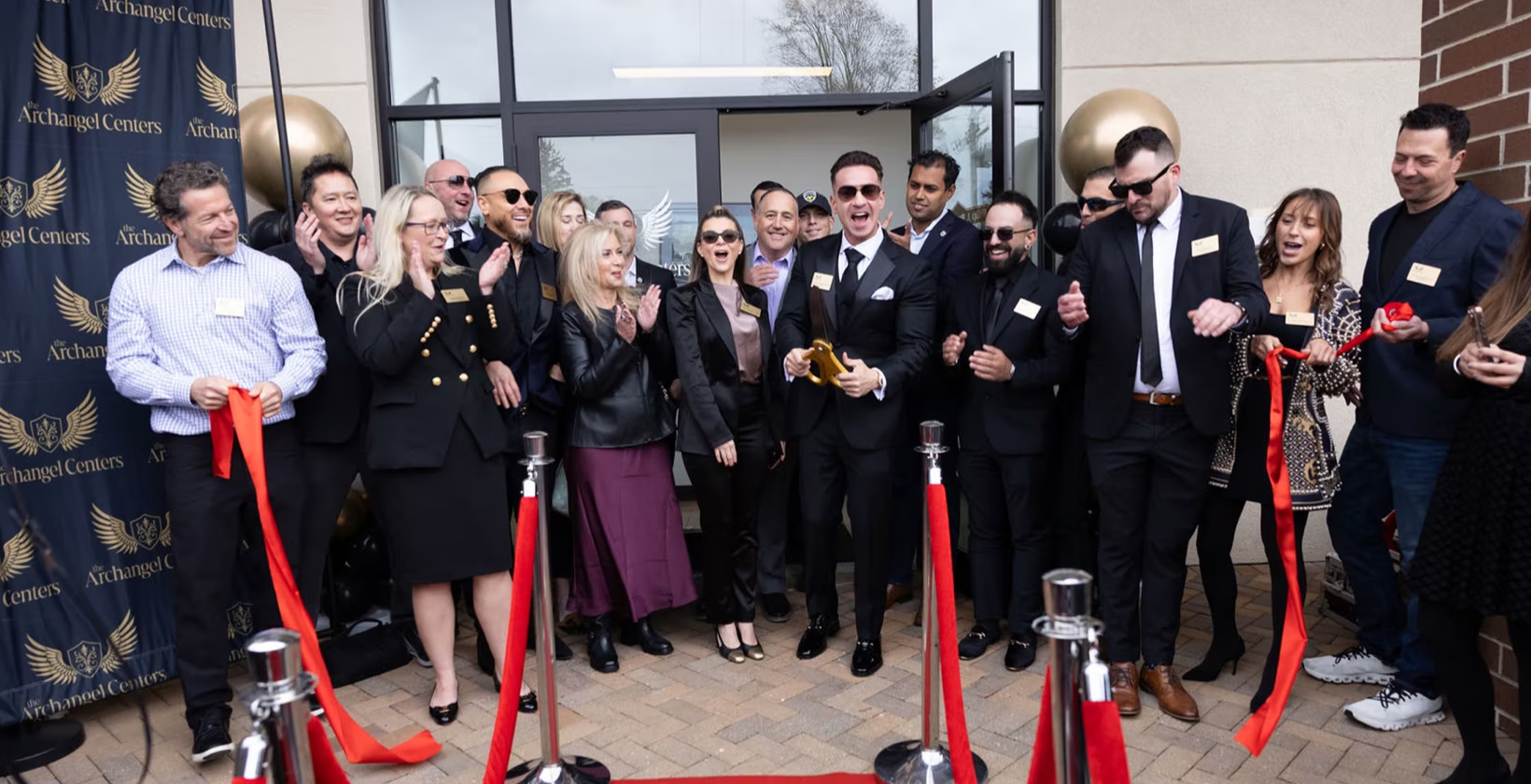
Our clinical model is medical and evidence-based. Founded in 2026 in Tinton Falls, NJ, with a Charlotte, NC location, the practice is anchored in co-founder Mike Sorrentino's long-term sobriety and in the principle that lived experience opens the door while licensed clinicians carry the work. Spirituality is one of several supplemental pillars offered alongside the core clinical curriculum, and it operates on patient choice.
In practice that means a few things. Patients for whom spirituality or religion is meaningful can bring it into individual therapy, can be connected to local clergy or spiritual mentors, and can be linked to faith-based community resources in their area. Patients for whom it is not meaningful do not encounter it in clinical hours, and the curriculum does not assume it. 12-step participation is informed and supported when patients want it, and alternative mutual-aid frameworks (SMART Recovery, Refuge Recovery, LifeRing, Recovery Dharma) are equally valid options [6]. Wellness programming in New Jersey, including mindfulness practice, yoga space, breathwork, and somatic and sound-healing offerings, is positioned as supplemental and is available to any patient, regardless of belief.
If you are weighing treatment and the religious dimension of recovery has been a sticking point in past programs, that point is settable here. The clinical work is the foundation. The meaning is the patient's to define. The family programming and aftercare structure are built to support both.
Frequently Asked Questions
Will I be pushed toward AA's higher power language even if I'm atheist?
Can secular meaning practice substitute for religious practice clinically?
What if my religion or faith community contributed to my addiction shame?
Does spirituality reduce craving or relapse, and what does the evidence show?
How is 'meaning' different from 'happiness' in recovery?
- [1] National Institute on Drug Abuse (NIDA) — Treatment and Recovery
- [2] American Society of Addiction Medicine (ASAM) — Definition of Addiction
- [3] Frankl V — Man's Search for Meaning (foundation of logotherapy and meaning-centered psychotherapy)
- [4] Seligman MEP — PERMA model of well-being and flourishing
- [5] Kelly JF, Stout RL, Magill M, Tonigan JS, Pagano ME — Spirituality in recovery: a longitudinal investigation
- [6] U.S. Surgeon General — Facing Addiction in America
- [7] National Institute on Alcohol Abuse and Alcoholism (NIAAA) — Alcohol Treatment Navigator: mutual-support groups
Related Programs & Resources
Whatever your relationship to faith or meaning, the clinical work is the foundation. Call (888) 464-2144 to speak with our admissions team, or verify your insurance confidentially before any commitment. 24/7, free, no obligation.
(888) 464-2144Verify Your Insurance