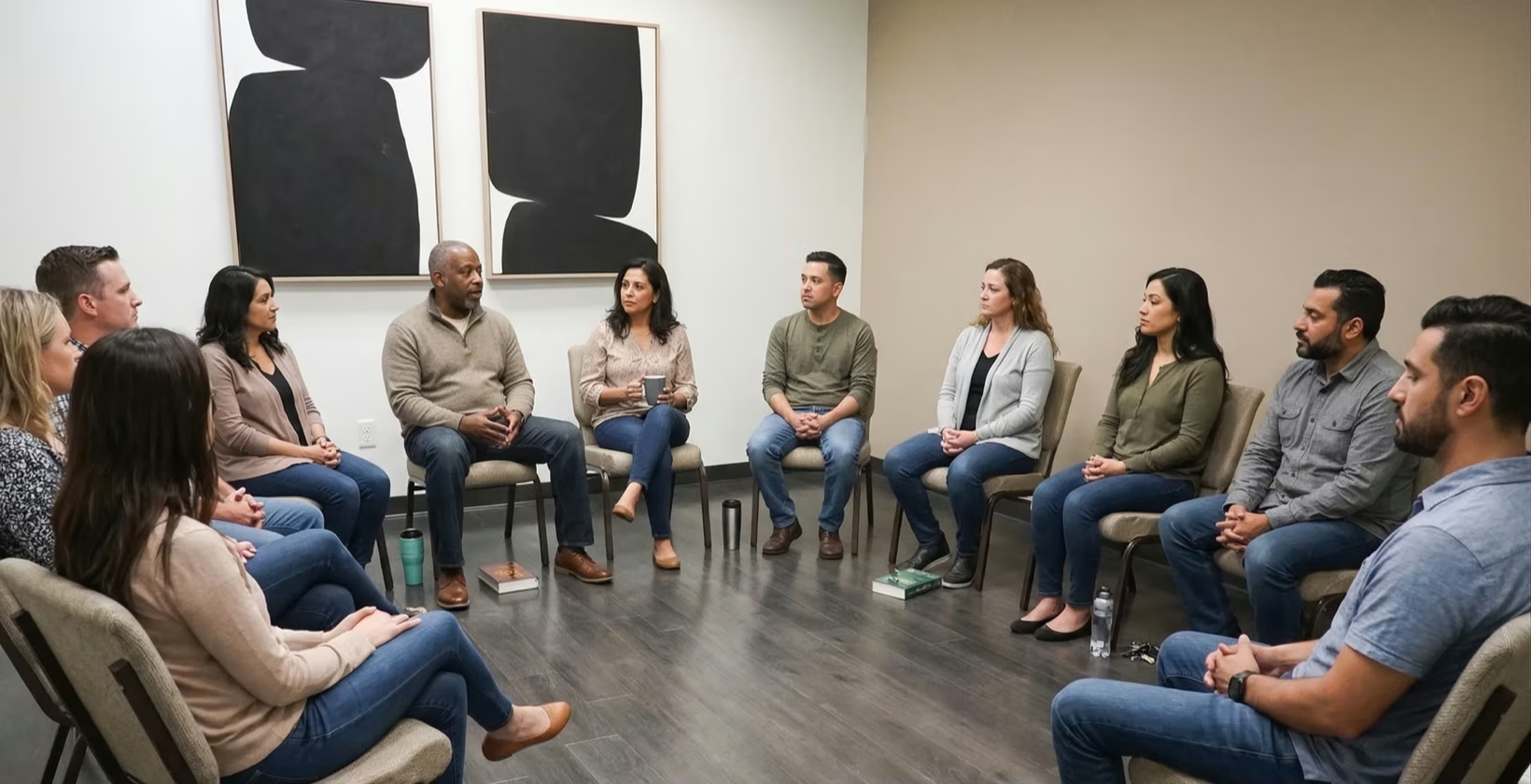
Protective Factors Against Addiction: Building Resilience
Addiction research has historically focused on risk: what makes substance use more likely. The complementary question, what makes substance use less likely, is equally important and less frequently studied. The protective-factors literature that does exist is consistent: certain positive variables reduce substance-use risk independently of the risks they coexist with [1][2]. Building protective infrastructure is not a substitute for treating risk where it exists, but for prevention, for early intervention, and for sustained recovery, the protective side of the equation matters as much as the risk side. This article describes the seven factors with the strongest evidence, what families can do, what adults in or near recovery can do, and how protection and risk interact across a life.
Why protective factors matter
Risk and protection are not mirror images. Removing a risk factor (treating a parent's alcohol use disorder, for example) helps. Adding a protective factor (a trusted coach, structured involvement, treated anxiety) helps in a measurably different way. SAMHSA's review of the prevention evidence found that protective factors operate independently of risk and that the strongest prevention outcomes occur when both sides of the equation are addressed together [1].
The clinical implication is straightforward. Families navigating a multi-generational history of substance use disorder cannot undo the genetics. What they can do is build the protective scaffolding the research has identified, because the same biology that makes risk heritable also makes protection effective [2][3]. The same logic applies in adult recovery: someone with five years sober is not safer because the disease went away. They are safer because the protective architecture (recovery community, treated mental health, daily structure, engaged relationships) is doing measurable work [4].
A practical frame for the rest of this article: where risk is high, protection is more important, not less.
The most consistently protective factors
Drawn from longitudinal studies across populations, seven protective factors recur in the prevention literature. None of them eliminate risk. Each independently reduces it, and the combination is more than additive [1][2].
- Stable, trusted adult relationship. A single reliable adult during adolescence (parent, grandparent, teacher, coach, mentor) substantially buffers against adverse-childhood-experience risk and against substance-use risk independently. The CDC's work on ACEs flags this as one of the highest-leverage protective relationships in the literature [4].
- Sense of meaning or purpose. Engagement in work, school, family, community, or faith that the person finds meaningful. The mechanism is partly motivational (something to live for) and partly biological: meaningful engagement activates reward circuits in ways that compete with substance-driven reward [2].
- Self-regulation skills. The ability to tolerate uncomfortable emotion without acting on it. Built in childhood through secure attachment and modeled regulation, or learned in adolescence and adulthood through therapy, mindfulness, and structured skill-building.
- Social connection. A sustained network of people who know the person and care about them. Isolation is a powerful risk factor; sustained connection is the opposite.
- Physical health behaviors. Sleep, exercise, and nutrition each independently support the brain systems that resist substance-use risk. Sleep deprivation alone measurably increases impulsive decision-making.
- Mental health treatment when needed. Treated anxiety, depression, ADHD, and PTSD substantially reduce substance-use risk. Untreated mental health conditions are among the strongest single drivers of substance use, and treatment is one of the most directly actionable protective levers [3].
- Delayed first use. Each year that first use is delayed beyond age 15 measurably reduces lifetime risk [2]. First use before 15 is one of the single strongest predictors of adult substance use disorder.
Protective factors for families to build
What parents and families can actually do, drawn from the family-prevention literature [5]. None of these depend on a particular income, household structure, or background; all of them depend on sustained attention.
- Open communication. Households where substance use is discussed calmly and repeatedly across years have lower adolescent use rates than households where the topic is avoided. One talk does not count; the pattern does [5].
- Clear expectations. Specific, age-appropriate expectations about substance use, paired with predictable consequences, outperform both vague prohibitions and permissive silence. A rule a child can recite outperforms a rule the family argues about in the moment.
- Parental monitoring. Knowing where children are, who they are with, and what they are doing, without surveillance-level control, is protective. The American Academy of Pediatrics frames this as engaged interest paired with developmentally appropriate autonomy [6].
- Modeling. Adult substance-use behaviors in the household shape adolescent expectations. Households where parents drink responsibly and openly produce different patterns than households where adult use is hidden or problematic.
- Quality time. Time spent together (eating, talking, doing things) builds the relationship that supports later difficult conversations. No prevention conversation lands without a relationship to land it on.
- Structured involvement. Sports, arts, religious community, jobs. Anything that gives the adolescent meaningful structure outside unstructured peer time. The specific activity matters less than the combination of engagement and reliable adults.
Protective factors for adults
For adults at elevated risk (family history, prior treatment, trauma history, untreated mental health), the protective-factors work continues to matter through adult life. The construction is different from adolescent prevention, but the underlying principles are the same: meaningful engagement, treated co-occurring conditions, daily structure, and connection [3][4].
- Recovery community. Sustained connection to a community of people in recovery is one of the strongest predictors of sustained recovery in adults with a history of substance use disorder [4]. The mechanism is partly social (cue substitution, modeling, accountability) and partly identity (a self-concept compatible with not using).
- Treated mental health. Anxiety, depression, ADHD, and PTSD treatment substantially reduces substance-use risk and relapse risk [3]. Co-occurring care is not optional for someone with both conditions; it is the standard.
- Engaged family relationships. Adult relationships with parents, siblings, partners, and children, when functional, are independently protective. Family programming during treatment exists for this reason.
- Meaningful work. Engagement in work the person finds purposeful supports the broader recovery architecture. Work fills time, organizes identity, and creates structure that protects against unstructured craving windows.
- Daily structure. Sleep, eating, movement, work, and social contact in regular rhythms. Unstructured time is risk for someone in recovery; structured time is protection.
- Self-regulation skills. Continued practice of the CBT, DBT, and mindfulness skills built during treatment. The skills do not stay sharp without use, and adult life regularly recreates the conditions they were built for.
The interaction of risk and protection
Protective factors do not eliminate risk. They modulate how risk expresses. A person with high genetic risk who has strong protective factors often does substantially better than the same person without them. A person with low risk who has weak protective factors may still develop a substance use disorder under the right environmental pressure [1][2].
The two sides of the equation interact, not subtract. Genetic risk is not erased by a trusted coach; it is expressed differently in a life with a trusted coach than in a life without one. ACE exposure cannot be unhappened; it is metabolized differently in a life with treated mental health and sustained connection than in a life without them. The biology that makes risk heritable is the same biology that makes protection effective: reward circuits, stress circuits, and prefrontal control respond to inputs, not to genealogy alone [3].
The practical implication for families: where risk is high, protection is more important, not less. Families with multi-generation addiction history have particular reason to build the protective infrastructure described above, both for adults in recovery and for the next generation. The work is concrete, repeatable, and supported by evidence [1][5].
Frequently Asked Questions
If I had no protective factors growing up, can I build them now as an adult?
Is one strong protective factor enough to offset multiple risks?
Do religious upbringings actually protect, or are they correlated with other protective factors?
How does adult recovery community function as a protective factor, mechanically?
Can pets or animals count as 'social connection' for protective-factor purposes?
- [1] Substance Abuse and Mental Health Services Administration (SAMHSA): Risk and Protective Factors
- [2] National Institute on Drug Abuse (NIDA): Preventing Drug Use among Children and Adolescents: Risk and Protective Factors
- [3] National Institute on Drug Abuse (NIDA): Common Comorbidities with Substance Use Disorders
- [4] Centers for Disease Control and Prevention (CDC): Adverse Childhood Experiences (ACEs) and Prevention
- [5] National Institute on Drug Abuse (NIDA): Family Checkup: Positive Parenting Prevents Drug Abuse
- [6] American Academy of Pediatrics (AAP): Substance Use Prevention and Parental Monitoring
Related Programs & Resources
Building the protective infrastructure that supports recovery, or prevents the disorder from developing, is family work. Our admissions team can help you start. Call (888) 464-2144, 24/7, free, no obligation.
(888) 464-2144Verify Your Insurance