



You’re not falling apart. You’re just falling asleep at the wheel.
You’re getting things done. You’re meeting deadlines. You’re still funny, still sharp, still “yourself”—at least when people are watching. But under the surface? You’re tired in a way that coffee, vacations, and self-help books can’t touch.
Maybe the drinking has picked up. Maybe it’s the only thing that turns the volume down at night. Or maybe it’s pills, food, weed, control—whatever you use to make the silence more bearable.
You haven’t lost your job, your marriage, or your reputation. But you’ve lost track of yourself.
If that’s where you are, we want you to know: you don’t have to wreck your life to get help. Our intensive outpatient program is built for people like you—high-functioning, burned out, and finally ready to ask: What if there’s a better way than just surviving?
High-Functioning Doesn’t Mean Well
Let’s be honest: the people who suffer the longest are often the ones who look the best.
You show up. You smile. You say you’re “just tired.” You manage. You cope. You explain everything away:
- “It’s just a stressful season.”
- “Everyone drinks after work.”
- “I still get everything done.”
- “I’ll cut back after this next deadline/trip/crisis.”
And maybe you do… until the next one comes.
The thing is, we don’t wait to change our oil when the engine’s on fire. We change it because we know what’s coming if we don’t.
You don’t have to wait for the fire. The fact that you’re here, reading this, means something in you already knows it’s time.
What an Intensive Outpatient Program Is—And Isn’t
An intensive outpatient program (IOP) is not rehab with a name change. It’s not group therapy “lite.” It’s not a punishment or a last resort.
Here’s what it is:
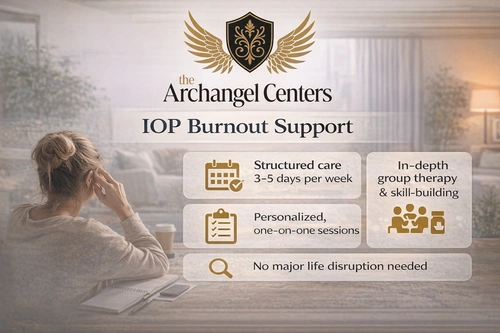
- Structured care, multiple days per week (usually 3–5)
- Group sessions that go beyond surface-level clichés
- Individual therapy with clinicians who understand nuance
- Skills training—not just to manage cravings, but to manage life
- Optional medication support
- A real-world schedule that works around jobs, kids, caregiving, or side hustles
You don’t disappear from your life to get help. You integrate support into your life so it doesn’t swallow you.
Why IOP Works for People Who Look “Fine”
Because we built it with you in mind.
High-functioning clients don’t need another lecture. They need a place where they can stop translating their pain into something palatable.
Here’s why IOP works for people still performing on the outside:
- It’s immersive, but not disruptive. You stay in your routine, but now there’s a lifeline inside it.
- It challenges your story. The one where “you’re fine,” “you’re just tired,” and “this will pass.”
- It creates emotional momentum. You’re not waiting for one session a week to make sense of it all. You’re in it. Actively. Daily.
- It gives you language. For what’s been happening under the surface that you couldn’t quite name.
- It meets your mind. You’re smart. You’ve read the books. This isn’t about preaching. It’s about connecting.
You don’t need to explain your job title before you explain your pain. You don’t need to minimize your success to justify your struggle.
You just need space to tell the truth. And tools to start building something better.
What a Typical Week in IOP Looks Like
We’ll be clear: this isn’t a drop-in group with donuts and vague advice. It’s structured care, held consistently. A week might look like:
- Monday: Group therapy (topics like emotional regulation, relapse prevention, communication)
- Tuesday: Skills training + individual therapy
- Wednesday: Rest day or personal work (journaling, support group)
- Thursday: Group session + optional medication check-in
- Friday: Wrap-up, goal-setting, accountability check-ins
Some people attend in the mornings before work. Others do evening sessions. Some attend virtually. Some come in person.
We offer flexible care in different locations because we know life doesn’t pause just because you’re healing.
“I Haven’t Hit Bottom” Isn’t a Reason to Wait
One of the most common things we hear is:
“I don’t think it’s bad enough for treatment.”
But let us ask:
- Are you drinking (or using) more than you planned—regularly?
- Do you feel out of control, even if everything looks controlled?
- Are you lying to people—or to yourself—about how much it’s affecting you?
- Have you tried to moderate, cut back, or stop…and found you can’t?
- Do you feel exhausted by the effort of looking okay?
That’s not “not bad enough.” That’s real pain, in real time.
And you deserve help that’s proportional to the depth of what you’re carrying, not just the visible damage.
What You’ll Take With You After IOP
Most people don’t leave IOP with everything “fixed.” But they do leave with:
- Clarity. About what they’re actually dealing with—not just what they feared it might be.
- Language. To talk about their patterns without shame.
- Community. Even if it’s just one person who said, “me too,” it matters.
- Support plans. For what happens next—whether that’s stepping down to outpatient, continuing therapy, or trying something new.
And maybe most importantly? They leave with a little more hope.
Not the fake kind. The kind that says, “Maybe I don’t have to do this alone anymore.”
FAQ: For People Who Look Fine, But Aren’t
Do I have to commit to full sobriety to join IOP?
No. We work with people at different stages of readiness. Whether you want to quit, cut back, or just understand your patterns—we meet you there.
Can I work while doing IOP?
Yes. Many of our clients do. We offer flexible hours (mornings and evenings), virtual options, and support navigating time off if needed.
Will my employer or family find out?
No. Your privacy is protected. And if you want support talking to your workplace or loved ones, we can help you navigate those conversations with care.
How long does IOP last?
Most people participate for 4–6 weeks. Some stay longer. It’s not a race—it’s a reset.
What if I try it and it doesn’t feel right?
That’s okay. We’ll help you explore other options. The door stays open. You’re not locked in. You’re invited.
You’ve kept it together long enough. Let us help you take care of the part of you that’s been carrying the weight. Taking the first step can feel overwhelming, but you don’t have to navigate this journey alone, serving in East Windsor, Tinton Falls.
Call (888) 464-2144 to learn more about our Intensive outpatient program in New Jersey.
