



Sometimes, the hardest part of recovery isn’t getting clean. It’s staying emotionally connected when things feel flat. If you’ve been sober for a while and still feel stuck or spiritually distant, you’re not doing it wrong.
This is more common than most people talk about. Many people assume that recovery is a steady, predictable process, but it’s not.
At Archangel Centers in New Jersey, we offer a drug addiction treatment program in Tinton Falls and East Windsor. We see this not as a setback but as a signal. A sign that something real is ready to shift again.
Recovery Growth Doesn’t Move in a Straight Line
In early sobriety, every day brought milestones. Getting through the first week. Making 30 days. Feeling your emotions come back online. You could measure progress in tangible ways: less chaos, more clarity. Now? It might feel like the color’s drained out. No big highs, no dramatic lows, just idling in neutral.
That doesn’t mean you’ve failed. It means you’ve stabilized.
After stabilization comes… space. Sometimes, space feels empty. But often, that space is where deeper emotional work begins. The kind that isn’t about surviving, but about meaning. Identity. Connection. Rebuilding a life of lasting well-being.
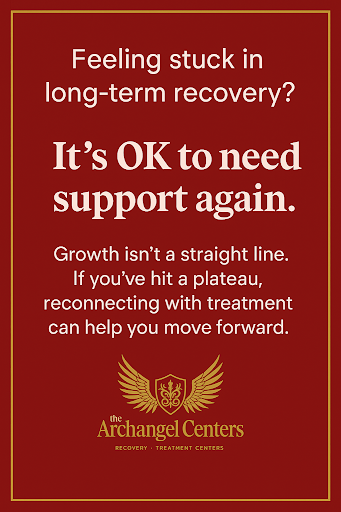
Feeling Emotionally Flat? You’re Not Alone
This sense of emotional flatness is more than just a bad week. It can feel like you’re watching life from a distance. You’re showing up, doing the right things, but not quite feeling them. The joy you expected in long-term sobriety might feel absent. You might even wonder if you’re broken.
You’re not. You’re experiencing a phase that most people in long-term recovery encounter at some point, especially after the external markers of success have been met. Career, housing, relationships—those things might be in place, but something internal still feels off.
It is not uncommon for individuals in long-term recovery to have thoughts and feelings like:
- “I hit a year sober and thought I’d feel amazing. But honestly? I just felt… nothing.”
- “Everyone kept saying it gets better. But after 18 months, I wasn’t sure what ‘better’ even meant anymore.”
- “I used to feel proud of my sobriety. Lately, I just feel disconnected from it. It’s like I’m watching my life happen from the outside.”
- “I’m not using, I’m not spiraling out of control… but I don’t feel alive either. It’s like the light never fully came back on.”
That feeling isn’t failure. It’s a pause. A recalibration. And it can be a doorway back into yourself. You’re not alone in this, even if it feels like nobody else talks about it.
Your Nervous System Is Still Catching Up
Drug addiction treatment is about more than stopping a behavior. It’s about healing an entire system, especially your nervous system. During active addiction, your brain and body learned to anticipate stress, numb pain, and prioritize survival. Recovery asks your system to shift, but that takes time. Years, sometimes.
Even long after the substances are gone, the body still carries old patterns. Hypervigilance. Disconnection. Emotional suppression. These aren’t signs that you’re failing; they’re signs that you’re still healing. And healing isn’t linear, either.
Feeling flat or emotionally distant might not mean you’re regressing. It might just mean your body is saying, “We’re not done yet.” That message deserves compassion, not criticism.
You Don’t Need a Crisis to Re-Engage
It’s common for long-term alumni to think support is only for people in crisis. You might tell yourself, “I haven’t relapsed, so I shouldn’t need help.” But needing help doesn’t require a breakdown. Emotional distance is enough. Spiritual numbness is enough. Even just wondering if you’re missing something… is enough.
Recovery is a lifelong process. Just because you’ve been out of formal treatment for a while doesn’t mean you’re done growing. In fact, some of the most meaningful shifts happen after the dust settles—when life is stable but still feels incomplete.
Whether it’s a therapist, an alumni group, or a new modality of healing, reaching out now before things spiral is a sign of strength. It’s a recommitment to yourself, not an admission of failure.
Signs You Might Be in a Growth Plateau
This isn’t about diagnosing yourself. It’s about understanding that recovery looks different for everyone. Growth plateaus are subtle. They creep in slowly. You might be in one if:
- You feel “blah” most days, even with structure in place
- Joy, connection, or purpose feel distant or hard to access
- You’re going through the motions, not feeling them
- You avoid your alumni group or stop reaching out
- You miss the intensity of early recovery (even if you don’t miss the chaos)
It’s okay if these resonate. They’re not red flags; they’re gentle invitations to re-engage. To explore a new layer of growth. To ask: What’s next for me?
What to Do When Sobriety Feels Hollow
This is where many people get stuck. They often feel guilty for not feeling grateful. You know you’re better off. You know how far you’ve come. But you don’t feel connected to it. And that disconnect can feel shameful.
Here’s the truth: gratitude doesn’t always show up as emotion. And sobriety doesn’t guarantee meaning. If things feel hollow, it’s not because you’re ungrateful—it’s because your next emotional layer is ready. The part that wants more than survival.
This is a good time to reconnect with your why. Not the one you gave in treatment. The one that lives deeper now. The one shaped by everything you’ve learned. At Archangel Centers, we help long-term alumni explore exactly that. Through trauma-informed care, creative therapies, and spaces where you don’t have to pretend everything’s okay, we offer a way to take your recovery to the next level.
If you’re in New Jersey, our locations in Tinton Falls and East Windsor are open to alumni who simply want to feel more again.
Recovery Is a Spiral Staircase, not a Finish Line You Cross Once
Think of recovery like a spiral staircase. You circle back to familiar emotions: grief, fear, boredom. But each time, you’re in a new place. A little more resourced. A little more present. A little more honest.
If you feel like you’re back in the same emotional place, ask yourself: What’s different this time? That’s how you know you’ve grown. You’re circling back not to repeat, but to evolve.
Call (888) 464-2144 or visit Archangel Centers online to talk to someone who gets it. Growth doesn’t have to be loud to be real.
