



There’s a line that many alumni cross after relapse — not a dramatic fall, not a blackout night, but a quiet unraveling that feels like:
“I did everything right, but something still broke.”
You held on for 90 days. You made it to graduation meetings. You worked the steps. You showed up. And yet, life got heavy — work stress, old triggers, an argument with someone you loved — and suddenly, you were back where you swore you’d never be again.
First:
That pain you’re feeling? Real. And valid.
Second:
You did not fail. You encountered a layer that early recovery wasn’t built to address.
That’s where a partial hospitalization program can make all the difference — especially after a relapse that shakes your confidence, your self‑trust, and your hope.
When 90 Days Isn’t Enough
Early recovery is powerful. It teaches:
- Structure
- Routine
- Accountability
- Sobriety basics
But it often doesn’t have the time or space to address why you drink, use, or numb in the first place — especially when the triggers are emotional, relational, or tied to lifelong patterns that can’t be fixed with meetings and good intentions alone.
After relapse, you might feel:
- Ashamed
- Confused
- Angry at yourself
- Afraid to try again
And underneath those feelings? There are deeper, human wounds that weren’t fully engaged in early recovery — and they’re whispering for attention now.
The Layer Early Recovery Often Misses
Early recovery focuses on stopping behavior.
That’s necessary. But it isn’t everything.
What early recovery can’t always address:
Unresolved Trauma
Not everyone enters recovery with a clear memory of what hurt them. Some pain sits quietly under the surface — shaping your reactions, your pain tolerance, your cravings.
Attachment Patterns
How you connect, how you cope when someone leaves, argues, ignores — these have roots decades deep and aren’t always unpacked in early reunions.
Emotional Regulation Skills
You learned to stop using, but did you learn how to tolerate grief, longing, disappointment, or anxiety without going into survival mode?
Subconscious Survival Scripts
You might be operating on instinct — not intention. And early recovery rarely has the bandwidth to rewire old neural pathways.
This is where a partial hospitalization program steps in. Not to judge. Not to punish. But to look deeper than a calendar date on the wall.
What Makes a PHP Different?
Think of early recovery as learning to walk again — it teaches you strength, stability, and forward motion after a fall. But what if the ground itself is unstable?
A Partial Hospitalization Program (PHP) helps you:
- Explore underlying patterns with clinicians who are trained to go beyond surface behaviors
- Understand your relapse triggers scientifically and personally
- Practice real coping strategies while you are still living in your daily world
- Test new choices in real time, with support
- Reframe emotional pain — not just avoid it
In a PHP, you’re not just learning how to stay sober — you’re learning how to live with purpose, connection, and awareness.
A Real Story, Not a Recovery Meme
Here’s the experience of someone who came back after relapse:
“I thought I knew recovery. I thought 90 days meant I was ‘fixed.’ Then life happened. I relapsed. I felt ashamed, like I had undone months of effort. But when I entered PHP, something was different — I wasn’t just learning rules, I was learning myself.”
They weren’t worse than anyone else. They were simply deeper into the work.
Here’s what they gained:
- Language for emotions they never acknowledged
- Tools for anxiety that didn’t involve escape
- Support that wasn’t based on guilt or fear
- A sense of identity that wasn’t only ‘sober’ or ‘not sober’
PHP helped them reconnect to themselves — not just to a recovery network.
Why Relapse Is Not the End — It’s a Signal
Your nervous system doesn’t relapse because you’re weak.
It relapses because something inside you hasn’t been truly heard yet.
Relapse is an alarm bell — not a death sentence.
It’s saying:
- “I need these feelings processed.”
- “I need support when life gets heavy.”
- “I need tools that work when the world doesn’t slow down.”
A partial hospitalization program doesn’t erase relapse.
It teaches you how to respond to it with clarity instead of shame.
How a PHP Meets You Where You Are
Unlike traditional outpatient care that meets once or twice a week, a PHP offers:
- Daily therapeutic environments
- Group work that mirrors real relational dynamics
- Individual therapy that gets personal and deep
- Skill development you can practice each night at home
And that’s crucial — because healing isn’t something that happens away from life.
It happens in life.
You learn patterns in therapy — and test them with your roommate, coworker, partner, or family that night.
That’s why PHP isn’t “more recovery.”
It’s deeper recovery.
Where Real Support Happens
If you’re wondering where this kind of care can be found, Archangel Centers offers structured partial hospitalization programs with a focus on depth, dignity, and real progress.
We serve individuals throughout New Jersey and provide environments that are warm, human, and grounded in clinical expertise — not judgment.
Our centers in:
…are places where alumni come back not because they failed — but because they’re ready to heal in a way that feels realistic, grounded, and sustainable.
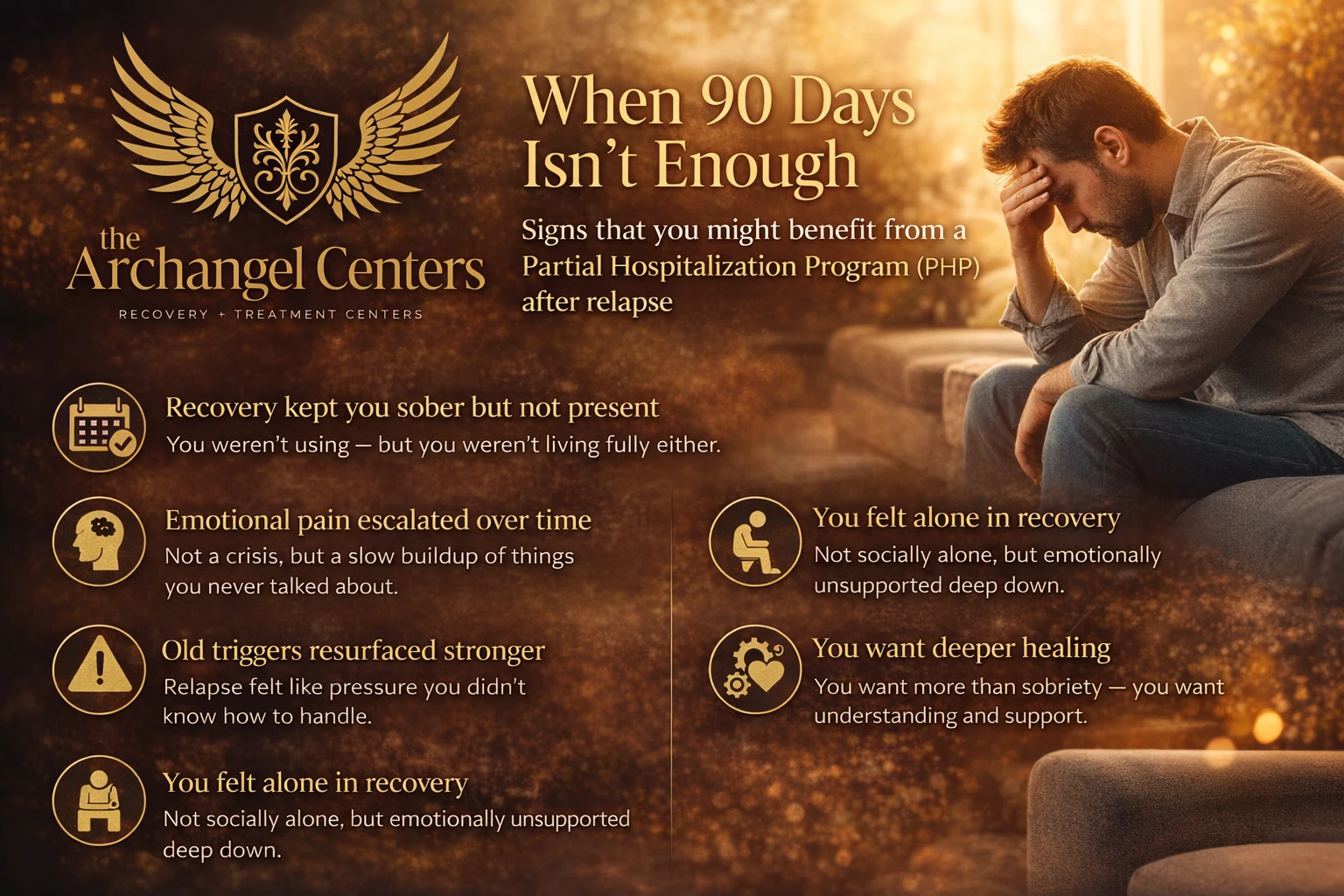
Spotting the Signs That You Might Benefit from PHP
Here are some experiences alumni share that led them back:
1. Recovery kept you sober but not present.
You weren’t using — but you weren’t living fully either.
2. Emotional pain escalated over time.
Not a crisis, but a slow buildup of things you never talked about.
3. Old triggers resurfaced stronger than before.
Relapse felt less like a stumble and more like pressure you didn’t know how to handle.
4. You felt alone in recovery.
Not socially alone, but emotionally unsupported deep down.
5. You wanted more than just sobriety — you wanted understanding.
These are not weaknesses. They are legitimate signals that your healing journey needs depth rather than distance.
What Alumni Say About PHP After Relapse
Some of the most hopeful narratives come from alumni who walked back in with skepticism.
“I thought I’d hear the same old therapy buzzwords. Instead, I found therapists who knew when to sit with my pain and when to challenge me with compassion.”
“I wasn’t looking for another program. I was looking for reflection — a place to finally understand why relapse felt inevitable. I found that here.”
“This time, it wasn’t about rules. It was about meaning.”
These stories aren’t rare. They’re testimony to what happens when care goes beyond checklist recovery and into human connection, emotional depth, and real habits of life.
Frequently Asked Questions (FAQs)
What makes a PHP different from outpatient aftercare?
PHP is more intensive — with daily therapeutic engagement, deeper clinical support, and the structure to truly process emotions while living your life.
Do I have to be sober to enter a PHP?
No. You can enter a PHP with curiosity, concern, or honest uncertainty — not just full sobriety.
Will a PHP feel like going backward?
No — it’s not a reset. It’s going deeper with support, not judgment.
Does PHP replace therapy afterward?
No — it usually complements ongoing therapy. It gives clarity and tools that continue afterward.
Can I work or go to school while in PHP?
Often yes — PHP is structured so you can return home each night and begin applying what you learn immediately.
How long does PHP last?
It varies per individual, but typically stays consistent until clear patterns are addressed and resilience strengthens.
Healing Doesn’t Mean Forgetting the Journey
You didn’t come this far only to stop here.
You didn’t relapse because you failed — you relapsed because life is demanding and your earlier toolkit wasn’t built for the depth of your experience.
Recovery is not a straight line.
It’s a many‑layered transformation. A partial hospitalization program meets you where early recovery couldn’t — with depth, reflection, and real‑world practice.
Call (888) 464‑2144 to learn more about our Partial hospitalization program services in New Jersey.
