



You stopped going. Maybe you ghosted. Maybe you meant to just miss a day or two and never went back. Maybe you’re not even sure why you left.
And now, there’s this quiet voice in the back of your head saying:
“Should I… go back?”
If you’re thinking about returning to an intensive outpatient program (IOP), you’re not alone. It’s more common than you think. And no matter how long it’s been—days, weeks, or months—you’re still allowed to come back.
At Archangel Centers in Tinton Falls, New Jersey, we know that recovery is rarely a straight line. People pause. They ghost. They get overwhelmed or scared or numb. And then… some of them come back. That doesn’t make them failures. It makes them real.
Here’s how to re-enter treatment with honesty, self-respect, and as little shame as possible.
Step 1: Understand That Leaving Doesn’t Disqualify You
Whether you walked out mid-group or just slowly stopped responding, you haven’t burned a bridge. Treatment centers expect some clients to disengage. It’s part of the process for many. What matters more than how or why you left—is your desire to return.
You don’t need to explain yourself perfectly. You don’t need to prove that you’re “ready now.” You only need to say, “I think I need help again.”
And that? That’s enough.
Step 2: Choose a Re-Entry Method That Feels Doable
If calling someone directly feels overwhelming, that’s okay. There are other ways to begin the conversation. You could:
- Send a short email to your old counselor
- Leave a voicemail during off-hours
- Text an admin staffer or case manager
- Submit a contact form on the website with just your name and “I want to come back”
It doesn’t have to be long. It doesn’t have to be brave.
One sentence can be the door you walk through.
Step 3: Expect Welcome, Not Shame
Your brain may run wild before you reach out:
“They probably think I’m a failure.”
“I embarrassed myself.”
“They don’t want to deal with me again.”
The reality? Most treatment staff will say something like:
“Thanks for reaching out—let’s figure this out together.”
We don’t keep score. You’re not “behind.” You’re simply in process.
Step 4: Ask About Re-Enrollment (It’s Not a Punishment)
Once you’ve reached out, the team will help you figure out the next step. It might include:
- A short check-in or reassessment (no pressure)
- Re-entry into the same group—or a different one
- Flexible scheduling if your availability has changed
- Support around new barriers (transportation, childcare, mental health symptoms)
You’re not “starting from scratch.” You’re restarting from where you actually are.
If you’re looking for something closer to home, our team can also help you explore options at our Central New Jersey IOP location or our East Windsor center.
Step 5: Be Honest About Why You Left (If You Want To)
You don’t owe anyone an explanation. But if you’re ready, you can share:
- “I got overwhelmed.”
- “I didn’t think I was making progress.”
- “I relapsed and didn’t know how to face it.”
- “I thought I could do it alone.”
Whatever the reason, it won’t be held against you. Saying it out loud may help you more than anyone else. Honesty isn’t a test—it’s a tool.
Step 6: Say What You Need This Time
Returning gives you the chance to ask for what wasn’t working before. Maybe:
- The group felt too big
- Your therapist wasn’t the right fit
- You needed more structure or less talking
- The schedule didn’t work with your life
Let us know. We’ll listen. We’ll adjust if we can. The treatment plan should serve you, not the other way around.
Step 7: Remember You’re Not Back at Zero
You might feel like you’ve undone all your progress. You haven’t.
Even the time away taught you something. Maybe it showed you what you miss when you’re disconnected. Maybe it helped you realize how much the IOP was actually helping.
You’re not starting over. You’re just continuing—with new clarity.
Why Do People Leave Intensive Outpatient Programs?
Because life is messy. Because healing isn’t linear. Because some days, showing up to group feels harder than drinking again. Because people hit emotional walls. Or because it just didn’t feel like the right fit.
None of those reasons mean you failed. They just mean you’re human. And humans circle back sometimes.
What Returning Clients Often Say
“I thought I’d feel ashamed. But I just felt relieved.”
“I was scared to come back—but everyone was kind about it.”
“It felt like rejoining a team, not admitting failure.”
Sometimes, you don’t realize how much treatment helped… until you stop. That realization alone is a sign you’re ready to engage again.
What If I Relapsed While I Was Away?
You’re still welcome.
Relapse happens. It doesn’t erase your progress. It doesn’t make you weak. It just means the old coping mechanisms crept back in—and now you’re asking for help again.
We treat relapse with the same compassion as anxiety, depression, or grief: as something that needs care, not judgment.
What Does an Intensive Outpatient Program Actually Involve?
Returning can feel less scary when you know what you’re coming back to. At Archangel Centers, our IOP generally includes:
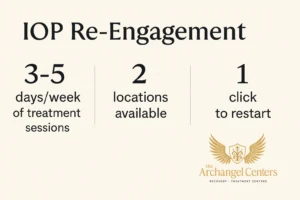
- 3 to 5 days a week of treatment sessions
- Group therapy, where you can connect with peers who get it
- Individual counseling to process personal struggles privately
- Psychoeducation, where you learn tools for real-world recovery
- Case management, if you need help with work, housing, or referrals
You return home after each day’s treatment. That flexibility helps many clients apply what they’re learning while still staying connected to daily life.
Looking for an Intensive Outpatient Program Closer to Home?
Our Tinton Falls center isn’t the only option. If you’re based elsewhere in New Jersey, we also offer services in:
Wherever you are, we’ll help you plug back in.
Frequently Asked Questions
Is it common to leave treatment and come back?
Yes—more than most people realize. Many clients pause due to life stress, fear, or emotional overload. Returning doesn’t make you an outlier—it makes you honest.
Do I need to explain why I left?
No. You can share if it helps you feel clear, but no long explanation is required. “I think I need support again” is enough to restart the conversation.
Will I be judged if I relapsed?
Not at all. Relapse is a known risk in recovery. We treat it with understanding and use it to tailor your treatment going forward—not to shame you.
Do I have to go back to the same group?
No. You can request a different group or therapist. You have options—and your preferences matter.
Can I change my schedule this time?
Yes. We’ll do our best to work with your availability. We know life doesn’t stop for treatment.
What if I’m not sure I can commit again?
That’s okay. You can start with a conversation—no pressure. Just reconnect. See what feels right. We’ll work with you, not against you.
Come Back When You’re Ready—We’ll Be Here
Call (888) 464-2144 or visit our Intensive Outpatient Program page to explore rejoining. No shame. No judgment. Just a clear next step.
