


Meth stays in your system for 2-7 days in urine, 1-3 days in blood, and up to 90 days in hair after last use, according to Ascendant NY clinical data.
Medical News Today reports the drug has a half-life of 6-15 hours, while The Healthier Choice Recovery narrows it to 10-12 hours, meaning your body clears half the substance in that window. But the full picture depends on the test, how often someone uses, and personal metabolism.
Hair tests catch use the longest because the drug gets locked into the hair shaft as it grows. Chronic users also test positive longer across every method, since repeated use causes meth to build up in body tissues and clear more slowly.
So what makes one person test clean in 3 days while another still tests positive at 10? And which testing methods are actually the most accurate?
Key Takeaways
- The CDC Clinical Drug Test Dashboard reports that methamphetamine is consistently detected in clinical urine drug tests for patients diagnosed with substance use disorders, confirming urine testing as a standard detection method in healthcare settings.
- Medical News Today identifies methamphetamine’s half-life as 6-15 hours, with The Healthier Choice Recovery specifying 10-12 hours, establishing the foundational timeline for drug elimination from the body.
- Ascendant NY clinical data shows urine tests detect methamphetamine for 2-7 days in most users, representing the most common detection window for employment and legal screening.
- Chronic methamphetamine use extends all detection windows significantly, with urine detection potentially lasting 7-10 days due to drug accumulation in tissues and slower clearance rates.
- Hair follicle testing provides the longest detection window at up to 90 days but cannot detect very recent use within the first 5-7 days, making it ideal for long-term monitoring rather than recent use detection.
How Long Does Methamphetamine Stay Detectable in Different Tests?
Methamphetamine detection windows vary dramatically depending on the biological sample tested and the sensitivity of the testing method used.
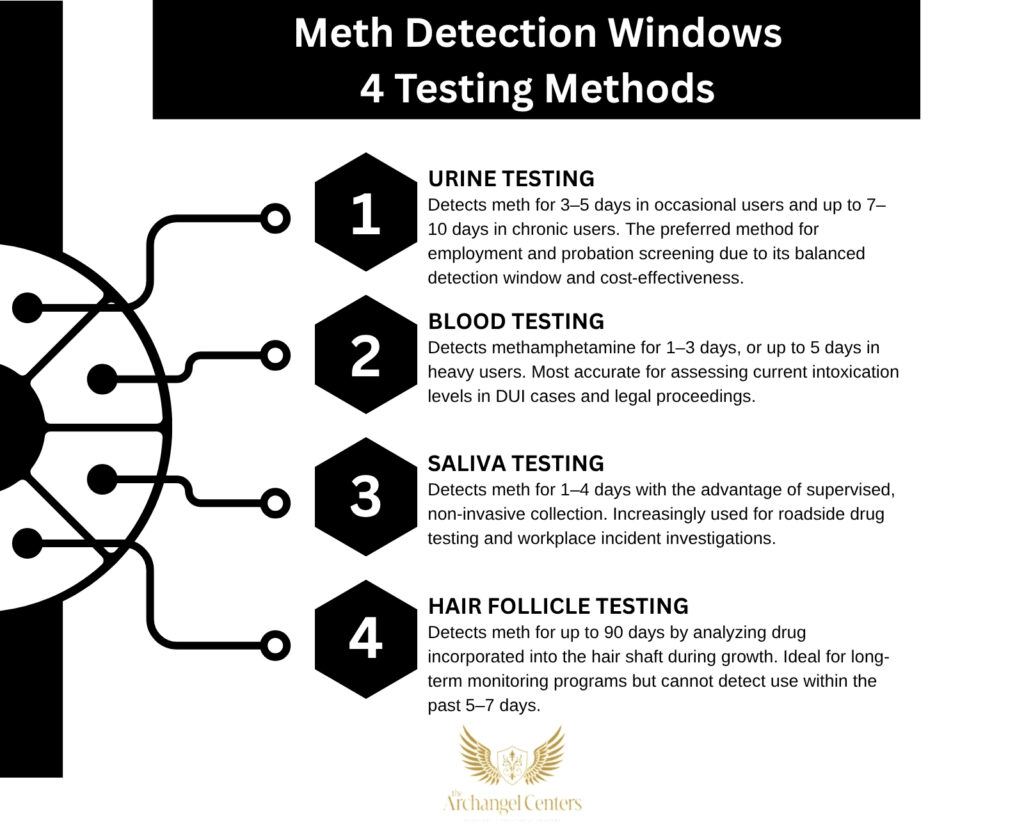
| Test Type | Detection Window | Accuracy Rate | Primary Use Case |
|---|---|---|---|
| Urine | 3-5 days (up to 7-10 for chronic users) | Very high | Employment screening, probation monitoring |
| Blood | 1-3 days (up to 5 for heavy users) | Very high | DUI cases, recent use detection |
| Saliva | 1-4 days | High | Roadside testing, workplace incidents |
| Hair Follicle | Up to 90 days | High | Long-term monitoring, legal proceedings |
The National Institute on Drug Abuse emphasizes that these windows represent general guidelines. Actual detection times are influenced by numerous biological and behavioral factors. ML, B. (2016) in a study titled Relationship between discriminative stimulus effects and plasma methamphetamine and amphetamine levels of intramuscular methamphetamine in male rhesus monkeys published in Pharmacol Biochem Behav established correlations between plasma methamphetamine concentrations and physiological effects. This demonstrates how blood levels directly relate to drug activity in the system.
Urine testing remains the gold standard for most screening programs. It offers an optimal balance of detection window, cost-effectiveness, and non-invasive collection. The Substance Abuse and Mental Health Services Administration reports that urine tests detect both the parent drug methamphetamine and its primary metabolite amphetamine. This provides comprehensive evidence of use.
Blood tests offer the shortest detection window but provide the most accurate measure of current intoxication levels.
What Factors Affect How Quickly Meth Leaves Your Body?
Individual metabolism plays the primary role in determining elimination speed. Genetic variations in liver enzymes affect how quickly the body processes methamphetamine. People with faster metabolic rates clear the drug more quickly. Those with slower metabolism retain detectable levels longer.
Body mass and composition significantly influence distribution and elimination patterns.
Methamphetamine is lipophilic, meaning it accumulates in fatty tissues and releases slowly back into the bloodstream. Individuals with higher body fat percentages may show extended detection windows as the drug slowly releases from adipose tissue. Hydration status affects urine concentration and elimination rates through the kidneys. Well-hydrated individuals may clear the drug faster through increased urine production, though this doesn’t significantly shorten detection windows for standard testing thresholds.
Frequency and amount of use create the most dramatic variations in detection times. EE, R. (2016) in a study titled PEGylation of a High-Affinity Anti-(+)Methamphetamine Single Chain Antibody Fragment Extends Functional Half-Life by Reducing Clearance published in Pharm Res showed that reducing clearance rates significantly extends detection periods. This illustrates how impaired elimination mechanisms prolong drug presence in the system.
Urine Testing: Most Common Detection Method
Urine testing detects methamphetamine for 3-5 days in occasional users and up to 7-10 days in chronic users. This makes it the preferred method for most screening programs.
The test measures both methamphetamine and its metabolite amphetamine. This provides confirmation of use even after the parent drug has been partially eliminated. Standard screening uses an initial immunoassay test with typical cutoff levels. Positive results trigger confirmatory gas chromatography-mass spectrometry testing.
False positives can occur with certain medications including some ADHD treatments, nasal decongestants containing pseudoephedrine, and specific antidepressants. However, confirmatory testing using different methodology typically eliminates these false positives. This achieves high accuracy rates in properly conducted laboratory analysis.
Blood and Saliva Testing: Shorter Detection Windows
Blood testing provides the shortest detection window at 1-3 days. It offers the most accurate assessment of current impairment levels. This method is particularly valuable in legal proceedings where recent use must be established. Blood concentrations correlate directly with physiological and cognitive effects.
Saliva testing offers a middle ground with detection periods of 1-4 days. It provides the advantage of supervised collection to prevent tampering. The method is increasingly used for roadside drug testing and workplace incident investigations due to its non-invasive nature and rapid results capability.
SS, T. (2021) in a study titled Comparative Neuropharmacology and Pharmacokinetics of Methamphetamine and Its Thiophene Analog Methiopropamine in Rodents published in Int J Mol Sci examined methamphetamine’s pharmacokinetic profiles to understand systemic clearance patterns. This demonstrates how different biological matrices reflect varying elimination rates.
Why Can Hair Tests Detect Meth for 90 Days?
Hair follicle testing achieves the longest detection window because methamphetamine incorporates into the hair shaft as it grows.
The process works through drug metabolites entering hair follicles via blood circulation during active hair growth phases. As hair grows at roughly 0.5 inches per month, a standard 1.5-inch sample provides about 90 days of use history. This makes this method ideal for long-term monitoring programs.
However, hair testing cannot detect very recent use within the first 5-7 days. It takes time for drug-containing hair to grow long enough for collection. Hair treatments including bleaching, perming, and excessive washing may reduce drug concentrations, potentially affecting test accuracy. Ethnic differences in hair structure can also influence results, with some studies suggesting varying detection rates across different hair types.
Despite these limitations, hair testing remains the gold standard for detecting historical use patterns in employment screening and legal monitoring programs.
How Does Chronic Use Change Detection Times?
Chronic methamphetamine use fundamentally alters elimination patterns by creating drug accumulation in body tissues, particularly fat stores and organs with high blood flow.
Regular users develop tissue saturation that extends detection windows across all testing methods. Urine detection potentially lasts 7-10 days compared to 3-5 days in occasional users. The phenomenon occurs because repeated dosing prevents complete elimination between uses, leading to cumulative buildup in adipose tissue, liver, kidneys, and brain tissue. When use stops, these stored reserves slowly release back into circulation, maintaining detectable blood and urine levels far longer than would occur after single-dose exposure.
Heavy users also experience altered metabolism due to the drug’s effects on liver enzymes and kidney function. Chronic methamphetamine exposure can impair the very organs responsible for drug elimination. This creates a cycle where detection windows become progressively longer with continued use.
Blood testing in chronic users may show positive results for up to 5 days instead of the typical 1-3 days, while hair testing becomes increasingly reliable due to consistent drug incorporation over extended periods.
Testing Accuracy and False Positive Possibilities
Modern methamphetamine testing achieves high accuracy rates when proper protocols are followed, with confirmatory testing reaching excellent reliability across different biological samples.
Initial screening tests using immunoassay technology can produce false positives requiring additional confirmation through gas chromatography-mass spectrometry analysis. Common medications that may trigger false positives include certain ADHD treatments containing amphetamines, over-the-counter nasal decongestants with pseudoephedrine, some antidepressants, and specific weight loss medications. The key distinction lies in the testing’s ability to differentiate between legal amphetamine compounds and illegal methamphetamine through structural analysis.
Workplace testing programs typically use a two-step process specifically to eliminate false positives, beginning with an initial screen and following positive results with confirmatory testing using different methodology.
Legal protections exist for individuals taking prescribed medications that may cross-react with methamphetamine tests. Medical Review Officers evaluate positive results in context of disclosed prescription medications, ensuring that legal drug use doesn’t result in false accusations of illegal substance use. Documentation from prescribing physicians typically resolves these situations during the review process.
Individual Metabolism and Personal Detection Windows
Understanding your personal detection window requires consideration of multiple biological factors that influence methamphetamine elimination rates.
Fast metabolizers with efficient liver enzyme systems may clear the drug significantly faster than average. Slow metabolizers may require substantially longer to reach undetectable levels. Genetic variations in cytochrome P450 enzymes, particularly CYP2D6, significantly affect methamphetamine processing speed. Individuals can be categorized as ultra-rapid, extensive, intermediate, or poor metabolizers based on their genetic makeup, with each category showing predictably different elimination patterns.
Personal factors that extend detection windows include higher body fat percentage, dehydration, impaired liver or kidney function, older age, and concurrent use of other substances that compete for the same metabolic pathways.
Individual variation can be substantial, with detection times varying considerably between people with similar usage patterns.
Other Drugs With Similar Detection Patterns
Several stimulant substances show comparable detection windows and elimination patterns to methamphetamine, making understanding these similarities crucial for comprehensive drug screening interpretation.
Cocaine demonstrates a shorter detection profile with urine positivity lasting 1-3 days for occasional users. Chronic users may test positive for up to 5-7 days, primarily due to its shorter half-life of approximately 1 hour compared to methamphetamine’s 10-12 hours. However, cocaine’s metabolite benzoylecgonine extends detection windows significantly, particularly in heavy users who may test positive for weeks. Stimulant addiction treatment programs often address multiple substances simultaneously due to cross-tolerance and similar neurochemical effects.
Prescription amphetamines including Adderall and Ritalin show similar urine detection periods of 2-4 days. These substances are often prescribed legally and require different interpretation during workplace screening. Prescription drug treatment addresses the growing concern of therapeutic medications becoming substances of abuse.
MDMA exhibits detection windows comparable to methamphetamine, with urine testing positive for 3-5 days and similar patterns of extended detection in chronic users.
Treatment for Methamphetamine Addiction
Stimulant Addiction Treatment Programs
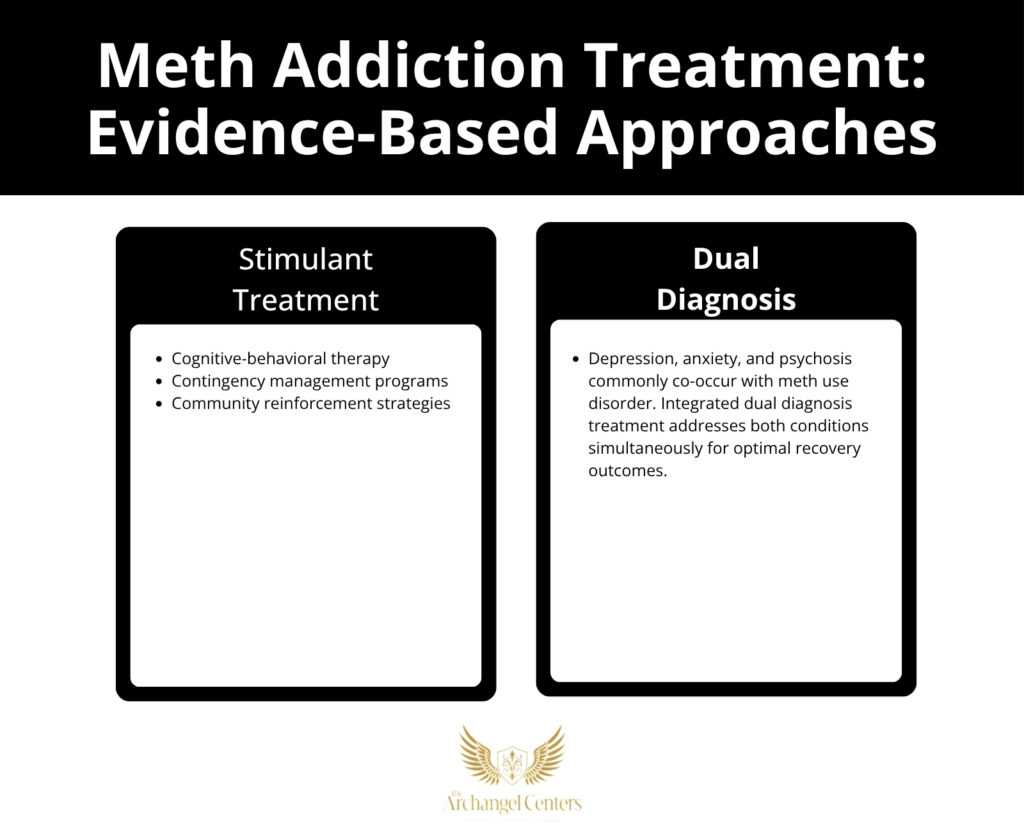
Comprehensive stimulant addiction treatment addresses the complex neurological and behavioral patterns associated with methamphetamine use disorder. These programs focus on cognitive-behavioral therapy, contingency management, and relapse prevention strategies specifically designed for stimulant drugs.
Intensive Outpatient Programming
Our intensive outpatient program provides structured support while allowing individuals to maintain work and family responsibilities during recovery. This approach is particularly effective for methamphetamine users who have completed initial detoxification and need ongoing behavioral intervention.
Dual Diagnosis Treatment
Many individuals struggling with methamphetamine use also experience co-occurring mental health conditions including depression, anxiety, and psychosis. Dual diagnosis treatment addresses both the substance use disorder and underlying psychiatric conditions simultaneously for optimal recovery outcomes.
Medical Supervision and Support
Professional medically supervised treatment provides the medical oversight and behavioral interventions necessary for safe, sustainable recovery from methamphetamine addiction.
The Bottom Line
Methamphetamine detection windows range from 1-3 days in blood to up to 90 days in hair follicles, with urine testing typically detecting use for 3-5 days in occasional users and 7-10 days in chronic users. If you or someone you love is struggling with methamphetamine use, professional addiction treatment can provide the medical supervision and behavioral interventions necessary for safe, sustainable recovery.
Archangel Centers specializes in evidence-based treatment approaches specifically designed for stimulant addiction, offering both intensive outpatient programs and dual diagnosis care to address the complex challenges of methamphetamine use disorder.
Frequently Asked Questions
Can drinking water help flush meth out of your system faster?
Drinking water does not significantly accelerate methamphetamine elimination from your body. While staying hydrated supports overall kidney function and may slightly increase urine production, it cannot overcome the drug’s inherent half-life of 10-12 hours. Excessive water consumption before testing may dilute urine samples, triggering invalid results that require retesting rather than producing negative results.
Will one-time meth use show up on a drug test after a week?
Single-use methamphetamine typically clears from urine within 3-5 days in healthy individuals with normal metabolism. After one week, most one-time users would test negative on standard urine screening. However, factors like slow metabolism, kidney dysfunction, or unusually high doses could extend this window. Hair testing could detect single use for up to 90 days if sufficient drug incorporated into growing hair.
Do meth detox products actually work to pass drug tests?
Commercial detox products marketed to help pass drug tests have no scientific evidence supporting their effectiveness for methamphetamine elimination. These products cannot alter the drug’s fundamental pharmacokinetics or half-life. Some products may temporarily dilute urine or mask drug metabolites, but modern testing protocols include validity checks that detect adulteration attempts, often resulting in automatic positive results.
How accurate are at-home meth drug tests compared to lab tests?
At-home methamphetamine tests typically achieve good accuracy but lower reliability compared to laboratory confirmation testing. Home tests use similar immunoassay technology as initial lab screening but lack the sophisticated confirmatory analysis available in professional laboratories. False positives from cross-reactive medications are more common with home tests, and these results cannot be used for legal or employment purposes.
Does methamphetamine stay in your system longer if you smoke it versus other methods?
The route of methamphetamine administration affects how quickly the drug enters your bloodstream but does not significantly change overall elimination time from your system. Smoking produces faster onset and higher peak blood levels, but the drug’s half-life remains 10-12 hours regardless of consumption method. Detection windows depend more on total dose, frequency of use, and individual metabolism than on smoking versus oral or injected use.
Can prescription medications affect methamphetamine test results?
Several prescription medications can cause false positive results on initial methamphetamine screening tests, including certain ADHD medications, nasal decongestants containing pseudoephedrine, some antidepressants, and specific weight loss drugs. However, confirmatory testing using gas chromatography-mass spectrometry can distinguish between legal medications and illegal methamphetamine use. Always disclose prescribed medications to the testing facility’s Medical Review Officer.
How long after quitting meth will I feel normal again?
Physical methamphetamine withdrawal symptoms typically peak within 24-72 hours and resolve within 7-10 days, coinciding roughly with the drug’s elimination from your system. However, psychological symptoms including depression, fatigue, and cravings can persist for weeks to months as brain chemistry normalizes. Cognitive function and mood regulation gradually improve over 3-6 months of sustained abstinence, with some individuals requiring longer recovery periods.
Can methamphetamine be detected in breast milk and for how long?
Methamphetamine readily passes into breast milk and can be detected for similar timeframes as urine testing, approximately 3-5 days after last use. Nursing mothers using methamphetamine expose infants to dangerous drug concentrations that can cause serious health effects including increased heart rate, agitation, and developmental problems. Medical professionals strongly recommend against breastfeeding during any period of methamphetamine use and for several days after discontinuation.
References
- B, ML. (2016). Relationship between discriminative stimulus effects and plasma methamphetamine and amphetamine levels of intramuscular methamphetamine in male rhesus monkeys. Pharmacol Biochem Behav.
- Centers for Disease Control and Prevention. (2024). Clinical Drug Test Dashboard. Retrieved from https://cdc.gov
- National Institute on Drug Abuse. (2024). Methamphetamine detection guidelines. Retrieved from https://nida.nih.gov
- R, EE. (2016). PEGylation of a High-Affinity Anti-(+)Methamphetamine Single Chain Antibody Fragment Extends Functional Half-Life by Reducing Clearance. Pharm Res.
- Substance Abuse and Mental Health Services Administration. (2024). Urine drug testing for methamphetamine and metabolites. Retrieved from https://samhsa.gov
- T, SS. (2021). Comparative Neuropharmacology and Pharmacokinetics of Methamphetamine and Its Thiophene Analog Methiopropamine in Rodents. Int J Mol Sci.