



No one tells you how much love can wreck you.
How exhausting it is to love someone who keeps slipping out of reach. How confusing it is to be proud, heartbroken, angry, and terrified—all at the same time.
When my 20-year-old started using again, I didn’t know what to do. Not really. I replayed everything we’d tried. Therapy. Time at home. Ultimatums. Grace. Tough love. Some of it helped for a while. None of it stuck.
I was out of tools. And what hurt most was this: no one had ever really explained what a partial hospitalization program (PHP) was—or how it could help people exactly like my son.
So I’m writing this now, for you. The parent who loves a kid who’s still struggling. The one who’s tired of Googling at 2 a.m., trying to make sense of acronyms and insurance and hope.
Here’s what I wish someone had explained to me earlier.
If you want to see the type of program I’m talking about, Archangel’s PHP is a good place to start.
I Thought There Were Only Two Options: Crisis or Waiting
Every time things got bad, we scrambled for solutions. ER visits. Detox. Therapy referrals. But between those moments, there was… waiting. Watching. Hoping things wouldn’t get worse.
No one said there was a middle ground—a place between “totally fine” and “this is an emergency.”
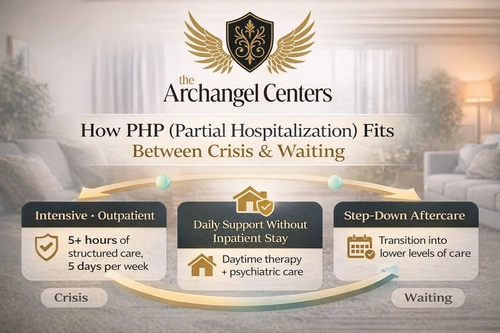
That’s where a partial hospitalization program lives. It’s not inpatient, but it’s not light-touch either. It’s real, structured care—without requiring a full-time residential stay.
Your child comes in for the day—5 days a week, usually for several hours—and gets support that’s deeper than outpatient therapy. Then they go home.
No locked doors. No giving up their whole life. Just space to get better, with real scaffolding.
PHP Didn’t Fix Everything—But It Changed Everything
Let me be honest: my kid didn’t walk into PHP and become a different person overnight.
But something did shift.
He wasn’t flailing alone anymore. He had daily structure, group and individual therapy, medication support, and people who weren’t me trying to help him figure himself out.
And I—finally—wasn’t the only one carrying the emotional load.
Because when your child is struggling, your world starts to revolve around their pain. Your days are spent managing moods, interpreting silences, wondering what kind of parent you are.
PHP didn’t erase our struggle. But it gave us a container for it. Somewhere it could land, instead of bouncing around our house like a grenade with the pin half-pulled.
What a Day in PHP Looks Like
Before PHP, I had no idea what my son would actually be doing all day. I pictured sterile hospital rooms or endless lectures. But it wasn’t like that.
His day usually included:
- Morning check-ins: A grounding start, checking mood, motivation, and intentions.
- Group therapy: Sharing space with others in similar situations. Not performative—just honest.
- Psychoeducation: Learning about brain chemistry, trauma, triggers, coping strategies.
- Skills groups: Communication, boundaries, emotion regulation, relapse prevention.
- Individual therapy: One-on-one time with a clinician he could actually connect with.
- Optional family sessions: Where I had space to learn how to stop trying to save him—and start supporting differently.
He left each day with new tools. And slowly, he began to use them.
Why PHP Worked When Other Things Didn’t
Weekly therapy wasn’t enough. He couldn’t hold on between sessions.
Inpatient felt too extreme. He wasn’t a danger to himself or others. He still wanted some control.
PHP met him where he was. Not in crisis—but not okay, either. It was just intense enough to feel held, just gentle enough to stay with.
And maybe most importantly: it didn’t rely on me. He had a team. A container. A plan. And I got to exhale—for the first time in years.
I Needed the Family Support More Than I Realized
When the program offered family therapy, I hesitated. I didn’t want to make it about me. I didn’t want to hear all the things I’d done wrong.
But that’s not what happened.
What happened was: I was given space to say, “I don’t know what to do anymore,” and be met with understanding, not blame.
I learned that enabling doesn’t mean love, and boundaries aren’t betrayal. I learned how to be his parent again, not his lifeguard.
And I met other parents—people holding the same fears, guilt, and exhaustion. I wasn’t alone anymore.
Programs like Archangel’s offer this family support because they know: addiction and mental health struggles happen in systems. And healing does, too.
What Happens After PHP?
This isn’t a quick fix. It’s not a 30-day miracle. But it is a starting point that leads to something more sustainable.
After PHP, most people step down to:
- IOP (Intensive Outpatient Programs) with fewer hours
- Weekly individual therapy
- Support groups that keep connection going
- Medication management or ongoing case support
There’s no cliff. There’s a path.
The goal isn’t to return to “normal.” It’s to build a new normal that doesn’t revolve around crisis.
If you’re looking for options nearby, you can explore available care in your area. You don’t have to figure it all out on your own.
What I Wish I’d Heard Sooner
- You are not failing as a parent because your child is struggling.
- You are allowed to get help even if they’re not ready.
- Support for your child doesn’t have to mean full-time inpatient.
- You can stop waiting for them to hit bottom. There are other ways.
FAQ for Parents Still in the Thick of It
Q: What if my child refuses to go?
You can’t force recovery. But you can offer an option that feels less overwhelming than inpatient. PHP gives them choice—and sometimes, that’s what gets them in the door.
Q: Can I stay involved without taking over?
Yes. Family involvement is encouraged—but in a way that supports your boundaries, too. You’ll learn how to care without carrying it all.
Q: How long does a PHP program last?
Typically 2–4 weeks, but it’s flexible. The focus is on readiness to step down, not a set timeline.
Q: Is this just for people with addiction?
No. PHP is also ideal for people struggling with depression, anxiety, trauma, or co-occurring disorders. If your child’s mental health is impacting their daily life, PHP may be the right fit.
Q: What if they’ve already relapsed multiple times?
Relapse is not failure—it’s a signal that more support is needed. PHP offers structured care for people who’ve tried other paths but need something more integrated.
You’ve carried more than you should have to. You’ve done your best. Let us help with the next step. Taking the first step can feel overwhelming, but you don’t have to navigate this journey alone, serving in East Windsor, Tinton Falls. Call (888) 464-2144 to learn more about our Partial hospitalization program in New Jersey.
