



If you’re reading this, you already know something has to change.
You’ve tried holding it all together. You’ve smiled through the fog, kept up appearances, done everything you were “supposed” to do. But inside, something’s been slipping.
You’re not in denial anymore. You’re just scared. You’ve never done this before. And now you’re wondering: What does real help even look like?
This blog isn’t about convincing you of anything. It’s here to gently explain what a partial hospitalization program (PHP) actually involves—so you can decide what’s right for you, with clear eyes and soft pressure.
If you want to explore options right away, you can learn about Archangel’s partial hospitalization program here.
What Is a Partial Hospitalization Program?
Let’s start with what it isn’t. It’s not a locked ward. It’s not inpatient. And it’s not 24/7.
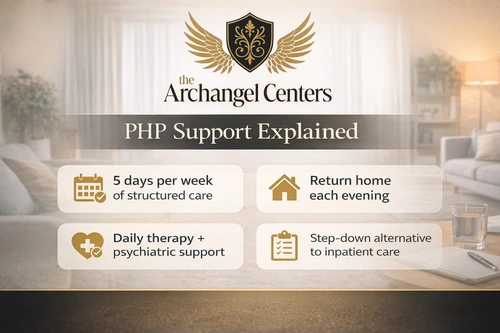
A partial hospitalization program is a structured, supportive treatment model where you spend several hours a day in care—usually 5 days a week—but go home each evening. Think of it as middle ground between inpatient hospitalization and traditional outpatient therapy.
It’s designed for people who need intensive support but still want to sleep in their own bed. It provides daily therapeutic programming, clinical support, and a safe environment to begin healing—without stepping completely out of your life.
Why People Choose PHP (Even When They’re Scared)
Most people don’t wake up one day and say, “I think I’ll do a partial hospitalization program.” They arrive there after a slow buildup of pain.
Maybe weekly therapy hasn’t been enough.
Maybe everything looks fine from the outside—but inside, it’s harder to function.
Maybe you’ve stopped trusting your own sense of “okay.”
Or maybe, you’re just done pretending.
PHP is for people who know they’re struggling—and want real help before it gets worse. It’s a way to press pause without disappearing. A place to be seen clearly, without judgment.
What a Typical Day Looks Like in PHP
Every program varies slightly, but here’s what you can usually expect from a PHP schedule:
Morning
- Check-in and mindfulness to ground you
- Group therapy focused on processing emotions, experiences, and triggers
- Skills-based sessions on topics like emotion regulation, healthy communication, or boundaries
Afternoon
- Individual therapy for personal, focused work
- Medication management (if applicable)
- Specialty groups such as trauma support, relapse prevention, or family education
You’ll take breaks. You’ll eat lunch. You’ll have space to breathe. And then—around mid-to-late afternoon—you’ll head home.
It’s intense, but not overwhelming. You’re not expected to perform. You’re just asked to show up, be real, and let us walk with you.
Who Will Be There With You?
One of the scariest questions people have is, Who else will be in the room with me?
You might picture a group of people wildly different from you. But the truth is, PHP groups are full of people who’ve spent years feeling alone in their struggle—only to find common ground when they finally speak it out loud.
In any given group, you might find:
- A young professional burned out by anxiety
- A parent overwhelmed by depression
- A college student who can’t stop dissociating in class
- A quiet person who’s been masking their pain for years
- Someone who looks just like you—but two weeks ahead in their healing
You don’t have to fit a type. You just have to be willing to step into a room where people are telling the truth.
What You Don’t Need to “Qualify”
Let’s clear this up:
- You don’t need a diagnosis to start
- You don’t have to be in crisis
- You don’t need to prove you’re “sick enough”
- You don’t have to explain everything perfectly
If something feels off, and it’s affecting your ability to live, function, or feel—that’s enough.
Our job isn’t to label you. It’s to listen, understand, and help you figure out what kind of support you need.
How PHP Helps People Reconnect With Themselves
In the beginning, people come to PHP hoping for relief. And they usually find it—but not always in the ways they expect.
What happens when someone finally feels safe enough to speak honestly? When their nervous system slows down just enough to feel again? When they realize they’re not the only one who feels this way?
That’s when things start to shift.
PHP helps people:
- Build emotional literacy—learning to name, feel, and respond to emotions
- Develop practical coping skills that hold up under stress
- Understand their symptoms (and their strengths) in context
- Reduce shame by hearing “me too” from others
- Create a structure that supports—not suffocates—their healing
- Reconnect with the parts of themselves they thought were lost
It doesn’t “fix” you. But it reminds you you’re not broken.
What Happens After PHP?
This isn’t a drop-off point. It’s a pivot point.
Most people step down into less intensive support, like:
- Intensive outpatient programming (IOP)—a few hours of treatment, a few days per week
- Weekly therapy with a trusted provider
- Medication management with psychiatric care
- Support groups or alumni connections
- Personalized recovery plans that fit your life and pace
The point isn’t to rush your exit. It’s to help you leave with tools and clarity, not confusion and fear.
You’ll know you’re ready—not because everything is perfect, but because you finally believe you can keep going.
Need help finding a program near you? You can also explore local options and support in your area.
What Makes Archangel’s PHP Different?
We built our partial hospitalization program with real people in mind—not just protocols. That means:
- You’re never treated like a number
- Your care plan is built with you, not just handed to you
- You’re met with clarity, compassion, and clear next steps
- You’re not pressured to fit a box—we adjust to your needs and goals
- You’re given space to move at your own pace, without being left behind
Explore how Archangel’s partial hospitalization program works. We’ll walk you through every step.
FAQ: What First-Time Clients Want to Know
Do I have to talk in group therapy?
No. You’ll never be forced to share. Many people listen for their first few sessions—and that’s okay. You’ll speak when you’re ready.
How long will I be in PHP?
It depends on your needs. Many people participate for 2–6 weeks. You’ll work with your team to figure out the right length for you.
Can I keep working or parenting while in PHP?
We’ll help you create a plan that balances your responsibilities with your healing. Some programs offer flexible hours to support caregivers or working adults.
What if I start and realize I need more (or less) support?
That’s part of the process. We can help you step up to a higher level of care—or transition to a lighter one—based on how you’re doing.
Is it weird that I’m scared?
Not at all. Everyone’s scared at first. It takes real strength to say, “I don’t want to do this alone anymore.”
You don’t have to figure it all out today. But you don’t have to keep struggling alone.
Call (888) 464-2144 to learn more about our Partial hospitalization program in New Jersey.
