



You didn’t mean to stop showing up.
Maybe it started with one missed session. Maybe you were overwhelmed before you even walked in. Maybe you never made it past the intake call.
If you’ve dropped out of an intensive outpatient program, ghosted your care team, or quietly told yourself “I’ll go back eventually…”—you’re not alone. You’re also not broken.
At Archangel Centers in Tinton Falls, New Jersey, we work with people every day who wanted recovery but couldn’t stay in treatment the first time. Especially people also living with trauma. And we want you to know: this doesn’t mean you failed. It means something in your nervous system is still trying to survive.
Let’s talk about what that means—and how to come back without shame.
1. PTSD Can Make Consistency Feel Unsafe
You might’ve been excited to start.
Motivated. Ready.
Then you hit week two—and everything felt harder than it should.
This isn’t laziness. It’s trauma.
PTSD doesn’t just show up in nightmares or flashbacks. It also shows up like this:
- Emotional numbness or zoning out in group
- Panic before sessions you can’t explain
- Shame after sharing
- Feeling exhausted for days afterward
An intensive outpatient program can be incredibly healing—but it’s also structured, social, and emotionally exposing. If you’re navigating PTSD, that can feel like too much.
Your body might be reacting to the idea of safety as if it were a threat. That’s not weakness. That’s a survival reflex. And it can be unlearned—with the right support.
2. Missing Sessions Doesn’t Mean You Don’t Care
A lot of people ghost their IOP not because they’ve stopped caring—but because they care too much.
You might think:
- “I’m behind now. I don’t want to be the one catching up.”
- “If I walk in after ghosting, everyone will judge me.”
- “They probably already removed me from the list.”
This is how shame works. It convinces you that absence equals rejection.
Here’s the truth: we know most people disappear because they’re overwhelmed—not defiant. Life got messy. Your trauma got louder. Your hope got quieter.
That doesn’t mean you’re not serious about recovery. It means you need a place that can hold your story—even the interrupted parts.
3. The Structure of IOP Isn’t Built for Everyone—But It Can Be Adapted
IOP typically includes:
- 3–5 sessions per week
- Group therapy
- Skill-building sessions
- Individual check-ins with a counselor
That can be a lifeline for many. But for someone dealing with complex trauma, it can also feel like too much, too fast.
If you’re neurodivergent, in survival mode, or working through long-held fear, the expectations of traditional outpatient care might feel out of reach.
That doesn’t mean it can’t work. It means it needs to flex around you.
At Archangel, we offer trauma-informed adaptations like:
- Slower ramp-up schedules
- One-on-one sessions before joining a group
- Restorative breaks and grounding options
- Clinicians trained in PTSD, dissociation, and complex trauma
We also offer care at nearby programs in Central New Jersey and East Windsor, so if distance was part of the strain, you still have options.
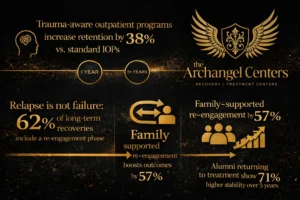
4. Recovery Doesn’t Have to Be Linear—Especially with Trauma
One of the hardest beliefs to let go of is this:
“I already had my chance.”
But healing—especially trauma recovery—isn’t a staircase. It’s a spiral. You circle back, return, revisit. Each time, with new insight.
Dropping out of IOP doesn’t mean the program didn’t work. It might mean:
- You started before your nervous system was ready
- You didn’t feel emotionally safe
- Life circumstances made consistency impossible
- You simply needed a break
All of that is part of the process—not a detour from it.
Coming back isn’t failure. It’s resilience.
5. You’re Still Allowed to Re-Enter—Even Quietly
You don’t need a dramatic comeback story.
You don’t need a perfect explanation.
You don’t need to promise anything.
You can just say, “I think I need help again.”
We’ve welcomed people back after three missed sessions—and after three years away. Every single time, we saw strength in that first step back.
We understand that reaching out again might feel harder than the first time. That’s why we meet you where you are. No lectures. No punishment. Just presence.
6. How to Come Back When You’re Not Sure You’re Ready
Let’s be honest: part of you probably still isn’t sure you can do this. That’s okay. Coming back doesn’t require certainty.
It just requires one step:
- Text your old counselor
- Call and leave a voicemail
- Send an email saying, “Can we talk?”
That’s it.
You don’t have to make a lifelong decision. You’re just re-opening the door a crack. We’ll meet you there.
FAQs: Ghosting, Trauma, and Coming Back to IOP
What if I left because I got overwhelmed and shut down?
That’s incredibly common, especially for people living with PTSD. We’ll talk through what triggered that shutdown and see how we can help make returning feel safer and more manageable.
Will I be in trouble for leaving mid-treatment?
No. You are not in trouble. We don’t penalize people for struggling. If anything, we admire your courage in thinking about re-engagement.
Can I adjust the intensity of the program?
Yes. Depending on your needs, we may recommend starting with fewer sessions, focusing on individual therapy first, or adjusting your care plan to reduce emotional overload.
I live near Tinton Falls but may need something closer—do you have options?
Yes. In addition to our Tinton Falls location, we have programs in Central New Jersey and East Windsor. We’ll help you find a fit that works for you.
What if I’m still unsure if I’m ready?
That’s okay. We can start with a no-pressure conversation to talk through what’s been hard. You don’t need to decide everything at once.
You’re Not Starting Over—You’re Starting From Experience
You’ve already done the hardest part once: showing up.
The fact that it got hard doesn’t erase that.
The fact that you stepped back doesn’t disqualify you.
If anything, it makes your return braver.
At Archangel, we don’t expect you to be perfect. We don’t need you to be confident. We only need you to be willing to try again—with us by your side.
It’s okay to come back. Quietly. Imperfectly. Exactly as you are.
Call (888) 464-2144 or Intensive Outpatient Program in Tinton Falls, New Jersey. Your spot isn’t gone. Your path isn’t closed. We’re still here.
