



Something has shifted.
Your child isn’t quite the same. Maybe they’re more distant. Maybe they’re skipping class or calling out of work more often. Maybe their moods are sharp and erratic—or frighteningly flat. And maybe, somewhere in the background, there’s alcohol.
For many parents, the realization is slow and sickening: This isn’t just partying anymore. Something is wrong.
If that’s where you are, this blog was written for you.
Alcohol addiction treatment in New Jersey can offer more than just clinical care. It can offer clarity in the fog. Direction in the chaos. And, for families, a way to move forward—together.
Why Young Adult Drinking Can Cross a Line—Fast
Not every drink is a crisis. But for some young adults, drinking is more than social—it’s self-medication.
Young adulthood is a complicated, often destabilizing phase. There’s pressure to perform, to choose a direction, to fit in, to function. When mental health struggles go undiagnosed or stress becomes too heavy, alcohol can slide in as a coping mechanism.
Unlike teenagers who may drink under peer pressure, young adults often drink alone or in emotionally loaded situations. That’s a red flag. The behavior might look like:
- Hiding alcohol or drinking in secret
- Drinking to fall asleep or “numb out”
- Increasing irritability, isolation, or apathy
- Repeated academic or work-related failures
- Mood swings that coincide with use or withdrawal
- Unexplained health issues or injuries
You don’t have to wait for rock bottom to take action. If you’re seeing changes that scare you, trust that instinct. You’re not overreacting—you’re noticing.
How Alcohol Affects the Young Adult Brain
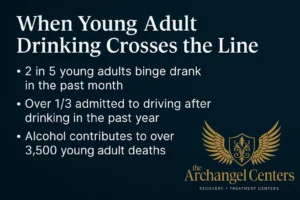
The human brain doesn’t fully mature until around age 25. During this time, alcohol can significantly alter brain chemistry and impair critical development—especially in areas responsible for judgment, impulse control, and emotional regulation.
What this means practically: A 22-year-old who starts drinking heavily may be interrupting key stages of emotional maturity. And once the brain links alcohol with comfort or escape, it can become a deeply rooted behavior that’s hard to unwind without help.
That’s why early intervention matters. Not just to stop drinking—but to restore development that’s been detoured by addiction.
What Alcohol Addiction Treatment Actually Looks Like
At Archangel Centers, alcohol addiction treatment is not about forcing young adults to “get it together.” It’s about creating the conditions where real healing can begin.
Our programs in Tinton Falls, Central New Jersey, and East Windsor are designed specifically for emerging adults—where emotional support, mental health care, and life skill-building intersect.
Key components often include:
• Clinical Assessment
A full picture of your child’s physical, psychological, and emotional health. We don’t just ask what they’re drinking—we ask why.
• Individual Therapy
One-on-one counseling to explore core struggles, identify unhealthy patterns, and begin reshaping thought-behavior cycles.
• Group Therapy
Peer-based support in a guided environment—so your child knows they’re not alone, even when it feels like it.
• Family Therapy
Because addiction impacts everyone, we include you. Our family sessions help rebuild trust, improve communication, and create healthy boundaries.
• Holistic and Life Skills Support
Many young adults need help with emotional regulation, stress tolerance, and basic structure. We support those needs too—without shame.
In some cases, medication-assisted treatment may be discussed—but only when appropriate and in alignment with your child’s treatment plan.
This is recovery made real: personal, responsive, and rooted in the developmental reality of young adulthood.
“But They Don’t Want Help”—Now What?
This is perhaps the most painful place to be: seeing your child suffer, but watching them resist the support they need.
First—know this: You are not powerless.
You can:
- Set boundaries with love (e.g., “We’re not willing to support you financially while you’re actively using.”)
- Offer choices, not ultimatums (e.g., “You can keep drinking, or we can look at a program together. But we can’t ignore this anymore.”)
- Talk to a counselor yourself, even if your child refuses help. Your clarity can change the family system.
Sometimes, simply planting the seed—“This isn’t working. And help exists.”—is enough to open the door when they’re ready.
Recovery Isn’t Just Abstinence—It’s Rebuilding
Too often, addiction recovery gets reduced to abstinence. But for young adults, healing is much broader.
Recovery means:
- Reconnecting with a sense of purpose
- Repairing relationships that were damaged
- Developing emotional tools that alcohol tried to replace
- Rediscovering interests and goals
- Learning how to feel without fleeing
It’s not always linear. It’s rarely fast. But with compassionate support, young adults can and do come back to themselves.
“It wasn’t like a switch flipped. But over time, I remembered who I was before I started drinking. And I started to believe I could be that person again.”
– Former client, 2023
What Parents Need to Hear—But Rarely Do
Let’s say this clearly:
- You did not fail.
- You did not cause this.
- Your love still matters—more than you know.
In fact, research shows that parental involvement is one of the strongest protective factors in long-term recovery. Even when your child pulls away. Even when words fail. Your presence—steady, loving, honest—can shift everything.
So if you’re hanging on by a thread, hang on. There’s still a way through this.
FAQ: Alcohol Addiction Treatment for Young Adults
What if my child doesn’t think they have a problem?
That’s common. Denial is often part of addiction, especially when peers normalize heavy drinking. A professional assessment can offer clarity. Sometimes hearing from a clinician—not a parent—opens the door.
How long does treatment take?
It varies. Some young adults engage in outpatient care for a few months; others benefit from longer-term support. What matters most is continuity—not rushing the process.
Can I be involved in their treatment?
Yes. At Archangel Centers, we view family as part of the healing system. You’ll be invited to participate in structured family therapy, updates, and education.
Do you treat co-occurring disorders?
Absolutely. Many young adults with alcohol addiction also face anxiety, depression, or trauma. Our team is trained in dual diagnosis treatment to ensure both are addressed together.
What if we live outside Tinton Falls?
We also serve young adults in Central New Jersey and East Windsor. If you’re not sure which location fits best, give us a call—we’ll help you find the right match.
Final Thoughts: Your Fear Is Valid—and So Is Your Hope
If your child is struggling with alcohol use, you may feel like you’re carrying the weight of their future on your shoulders. You may be afraid to hope, afraid to act, or afraid to let go.
All of that is valid. And you are not alone in this.
Archangel Centers exists to meet young adults in crisis—and their families—with steady hands and a clear path forward.
Call (888) 464-2144 to learn more about our Alcohol Addiction Treatment services in Tinton Falls, New Jersey.
You don’t have to do this alone. We’re here to help you take the next step—whatever that looks like today.
